Dueling like in Ancient Rome with 古代
Kanji Explanation: Oldness and antiquity with 古
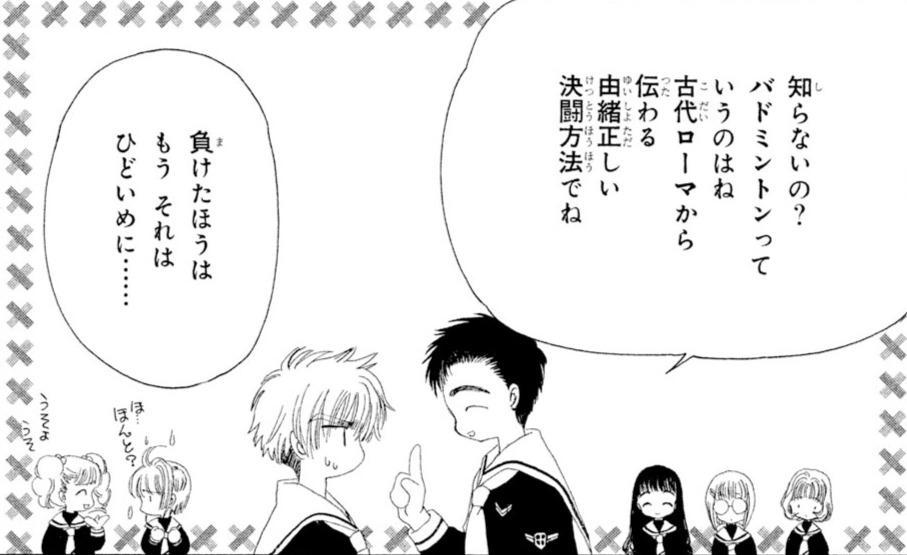
Li seems fired up over something with Sakura. Yamazaki suggests whatever the issue is be settled when they play badminton during that day’s physical education class. Li asks why things have to be settled via badminton.
- 山崎:
- 「知らないの?バドミントンっていうのはね 古代ローマから伝わる由緒正しい決闘方法でね」
- “You don't know? Badminton is a time-honored method of dueling that has been passed down since ancient Rome.”
- 「負けたほうはもう それはひどいめに……」
- “The loser suffers a truly terrible fate.”
Key Points
- 古代 means “ancient times” or “antiquity”. Here it combines directly with ローマ to name the historical period.
- っていう is the casual spoken form of という. バドミントンっていうのは means roughly “as for the thing called badminton” and sets up Yamazaki’s explanation.
- The clause 古代ローマから伝わる describes 由緒正しい決闘方法: a time-honored dueling method handed down from Ancient Rome.
- Here から marks the claimed source, not a reason meaning “because”.
- In っていうのはね and でね, Yamazaki uses ね to hold Li’s attention as he spins out the story.
- The で in 方法でね is the connecting form of the copula だ. It leaves the thought open for the warning about the loser.
- 負けたほう means “the one who lost” or “the losing side”. The pause lets it act as the topic: 負けたほう(は)もう…….
- The idiom is ひどい目に遭う, “have a terrible experience”. Yamazaki leaves 遭う unsaid, and the ellipsis makes the fate sound ominous.
Vocabulary
| Word | English | Meaning |
|---|---|---|
| 知る | To know | 知る means to learn or come to know a fact or person. In the form 知っている, it describes already knowing. |
| バドミントン | Badminton | バドミントン is badminton, the racket sport played with a shuttlecock. |
| 古代 | Ancient times | 古代 means ancient times or antiquity, especially in historical writing. |
| 伝わる | To be handed down | 伝わる is for something to be passed on, such as a tradition from the past, or for a message or feeling to get across. |
| 由緒正しい | Time-honored | 由緒正しい describes something with a long, respectable history. |
| 決闘 | Duel | 決闘 means a duel between two opponents. It has a formal, dramatic ring. |
| 方法 | Method | 方法 is a way of doing something to reach a goal. |
| 負ける | To lose | 負ける is to lose a game, fight, or contest. |
| それ | That | それ points to something near the listener, or to something just mentioned. |
See Also
- Kanji: Oldness and antiquity with 古
- Grammar: Marking the topic with は and も
- Grammar: Reasoning with 〜のだ
- Grammar: Connecting actions with 〜て・〜で
- Grammar: Seeking agreement with ね
- Idiom: Having a bad experience with 〜目に遭う
- Grammar: More than with 〜方が and 〜より
- Grammar: Quoting and reporting with と and って
- Grammar: Negation with 〜ない
- Grammar: How casual contractions work