Eating watery food with 〜っぽい
Grammar Explanation: Kind of like with 〜っぽい
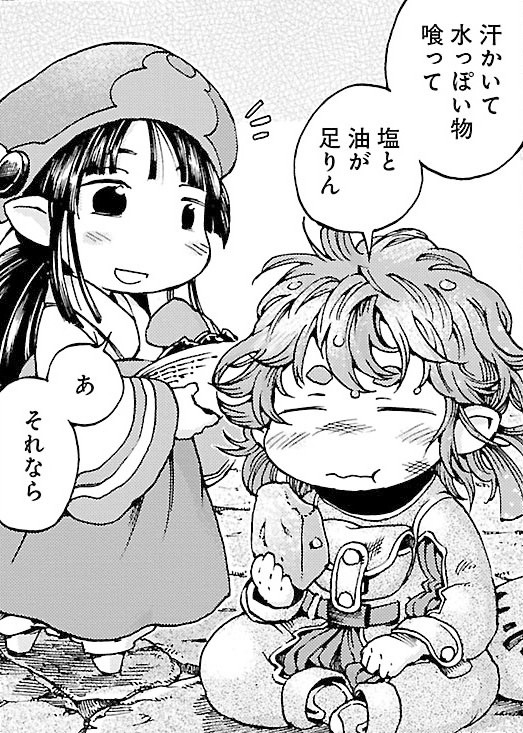
Hakumei has spent the day helping the carpenters’ guild repair a stone wall, while Mikochi helps cook for the crew. When the work stops for a break, everyone gets slices of a huge watermelon.
- ハクメイ:
- 「汗かいて水っぽい物喰って 塩と油が足りん」
- “I've been sweating and eating watery stuff. I'm short on salt and fat.”
- ミコチ:
- 「あ それなら」
- “Oh, in that case...”
Key Points
- With some nouns, っぽい means “full of” the noun rather than “like” it. 水っぽい food has a lot of water in it, and watermelon is the obvious case.
- It’s often a complaint, as with a watery soup. Hakumei isn’t faulting the watermelon, though. She’s saying it can’t give her what she’s missing.
- 汗かいて and 喰って are て-forms. They line up what has happened, and 塩と油が足りん is the result.
- The full phrase is 汗をかく, “to sweat”. Casual speech drops the を.
- 喰う is the rough word for “to eat”, more often written 食う. Polite or neutral speech uses 食べる.
- 足りん is 足りない, “not enough”, with the blunt ん negative. Hakumei often talks this way.
Vocabulary
汗をかく (To sweat)
汗をかく is to sweat or perspire. Casual speech often drops the を: 汗かく.
水っぽい (Watery)
水っぽい describes food or drink that has too much water in it, such as a thin soup or a bland, watery fruit.
っぽい (-ish)
っぽい follows a word to say something seems like it or tends toward it.
物 (Thing)
物 is a physical thing or object.
喰う (To eat)
喰う is a rough, masculine-sounding word for “to eat”, the same word as 食う in a less common spelling. It can also mean to bite or sting, or to use up time or money.
油 (Oil)
油 is oil, such as cooking oil or fuel oil. In talk about food, it also covers the fat or grease in a dish.
足りる (To be enough)
足りる means to be enough or sufficient. It most often appears as 足りない, “not enough”, “short of”.
See Also
- Grammar: Kind of like with 〜っぽい
- Grammar: Connecting actions with 〜て・〜で
- Grammar: Negation with 〜ない
- Kanji: Things and kinds with 物