Ended up relying on your help with 〜てしまう
Grammar Explanation: Doing completely or ending up doing with 〜てしまう and 〜ちゃう
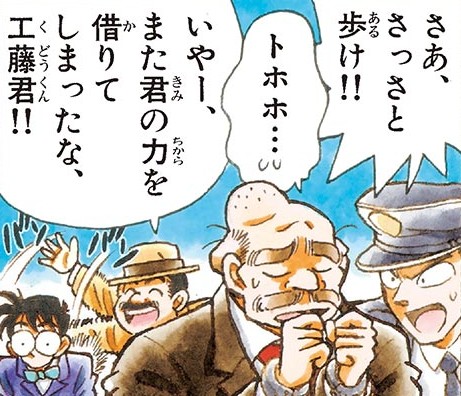
After Kudo helps Inspector Megure solve a murder case, he also catches the fleeing culprit.
- 警察官:
- 「さあ、さっさと歩け!!」
- “Come on, hurry up and walk!!”
- 目暮:
- 「いやー、また君の力を借りてしまったな、工藤君!!」
- “Man, I ended up relying on your help again, Kudo!!”
- Literal: “Man, I ended up borrowing your strength again, Kudo-kun!!”
Key Points
1借りてしまった = ended up relying on
- 君の力を借りてしまった means Megure ended up borrowing Kudo’s help again.
- Here 〜てしまった presents the help as something that happened completely and before Megure quite expected it, giving the line a delighted “you really came through for me again” feeling rather than regret.
2て connects a verb and its helper verb
- 借りて connects relying on Kudo to しまった. Megure uses しまった to frame the reliance as a completed, unexpected result and put the combined predicate in the past tense.
3力を借りる is a set phrase
- 力を借りる literally means “borrow someone’s strength”, but in context it means “rely on someone’s help” or “get someone’s assistance”.
- The object marker を marks 君の力 as the thing Megure borrowed.
4また and な show pleased familiarity
- また means “again”, implying this is not the first time Megure has needed Kudo’s help.
- The sentence-ending な here is a self-directed, reflective ending, matching Megure’s warm satisfaction as he addresses Kudo.
- 君 is an honorific suffix used after names, typically for boys or men. It’s commonly used by teachers addressing male students, by friends among young people, or by superiors addressing junior colleagues, and can also be used for girls in childhood or casual contexts.
Vocabulary
力 (Power)
力 means strength, power, force, or ability, depending on context.
See Also
- Grammar: Doing completely or ending up doing with 〜てしまう and 〜ちゃう
- Future entry: Past tense with 〜た・〜だ
- Grammar: The plain imperative
- Grammar: Connecting actions with 〜て・〜で
名探偵コナン © its respective creators. It is used here for educational commentary.