Endless coral reefs with 珊瑚礁
Kanji Explanation: Reefs and grounding with 礁
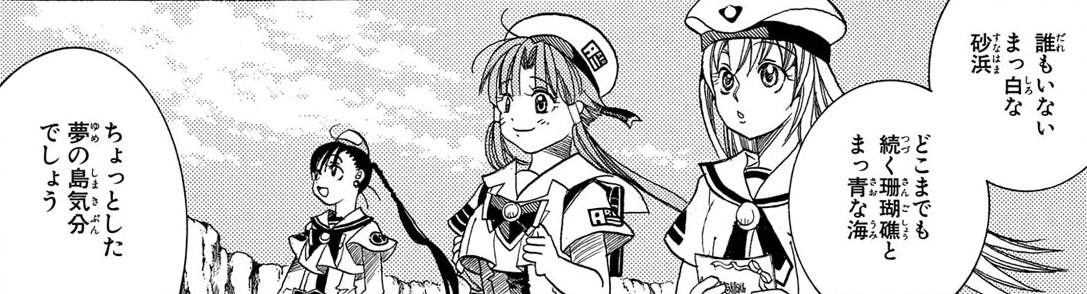
Akari, Aika, and Alice each received a mysterious invitation to “Neverland” and followed it to a small island. On its beach they found Alicia and Akira waiting in swimsuits. Alicia explains that President Aria planned the invitations and that this is a secret beach he found years ago. She adds that the Neo-Adriatic Sea has so many islands that plenty of hidden spots like this remain.
- アリシア:
- 「誰もいない まっ白な砂浜 どこまでも続く珊瑚礁とまっ青な海」
- “A pure white beach with no one on it, coral reefs stretching on and on, and a deep blue sea.”
- 「ちょっとした夢の島気分でしょう」
- “It feels a bit like a dream island, doesn't it?”
Key Points
- 珊瑚礁 means a coral reef. 珊瑚 is coral, and 礁 is a reef or rocky shelf just under the water.
- The word is also often written サンゴ礁, with coral in katakana.
- どこまでも means “to wherever” or “endlessly”. With 続く (“to continue”) it means “continuing on and on”.
- The whole phrase どこまでも続く sits in front of 珊瑚礁 and describes it, the way a relative clause does in English. Together they mean “coral reefs that go on and on”.
- The prefix 真っ intensifies a color word. まっ白 is pure white and まっ青 is deep blue. Here it is written in kana as まっ.
- まっ青 reads さお, not あお. Both take な before a noun: まっ白な砂浜, まっ青な海.
- 誰も with a negative verb means “no one”. 誰もいない砂浜 is a beach with nobody on it.
- 気分 after a noun means feeling as if you were in that situation. 夢の島気分 is the feeling of being on a dream island.
- ちょっとした softens it to “a bit of”. Alicia’s でしょう invites the girls to agree, like “doesn’t it?”
Vocabulary
| Word | English | Meaning |
|---|---|---|
| 誰 | Who | 誰 asks which person. |
| いる | To be | いる is to exist or be somewhere, for people and animals. After a て-form verb, it shows an ongoing action or a continuing state. |
| まっ白 | Pure white | まっ白, also written 真っ白, describes something completely white, like fresh snow or blank paper. It also describes a mind gone blank. |
| どこまでも | Endlessly | どこまでも means as far as something goes, without end. It describes a view that stretches on, or doing something persistently to the very end. |
| 続く | To continue | 続く is for something to go on without a break, such as rain, a road, or a story. It also means to come next, after something else. |
| 珊瑚礁 | Coral reef | 珊瑚礁 refers to reef structures built up by coral growth in warm seas. |
| まっ青 | Deep blue | まっ青, also written 真っ青, describes a deep, vivid blue, like a clear sky or sea. Said of a face, it means deathly pale. |
| 海 | Sea | 海 is the sea or ocean, the large body of salt water that covers much of the earth. |
| ちょっとした | Slight | ちょっとした goes before a noun to mean a small or minor thing. It can also mean “quite a” thing, something more than ordinary. |
| 夢 | Dream | 夢 is a dream, the images you see while asleep. It also means a hope for the future, and 夢のよう describes something too good to seem real. |
| 島 | Island | 島 is an island, a piece of land surrounded by water. |
| 気分 | Mood | 気分 is how you feel at the moment, in mood or in body. 気分が悪い can be feeling sick as well as feeling annoyed. |