Enthusiasm in giving a bribe with ノリ気
Vocabulary Explanation: Enthusiasm with 乗り気
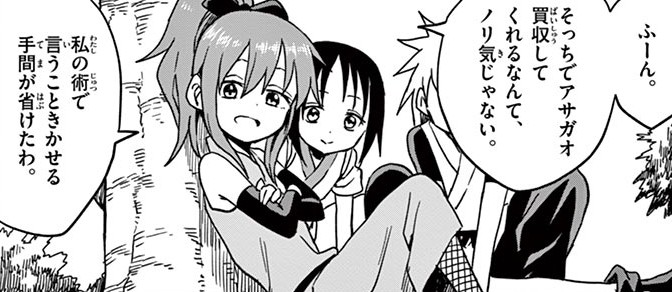
Hinagiku wants to see behind Rindou’s mask. Since Sazanka was scolded for trying the same, Hinagiku suggests they team up to take Rindou’s mask away. Asagao opposes the proposition, but Sazanka immediately quiets her by offering a bribe for her support.
- ヒナギク:
- 「ふーん。そっちでアサガオ買収してくれるなんて、ノリ気じゃない。」
- “Hmm. If you're willing to bribe Asagao on your side, you're pretty into this, aren't you?”
- Literal: “Hmm. If you'll bribe Asagao on your side, your riding spirit is there, isn't it?”
- 「私の術で言うこときかせる手間が省けたわ。」
- “Saves me the trouble using my technique to make her do as I say.”
Key Points
- Here ノリ気 means someone is getting into the plan and showing willingness to participate.
- 買収してくれる presents the action as something Sazanka is doing on their side or for their benefit.
- That helps the line feel like “if you’re even willing to bribe Asagao for this…”
- そっちで does not mean physical location here; it frames the bribing as the part Sazanka will handle.
- This unpacks as “if you’re going to take care of bribing Asagao on your side”.
- The ending ノリ気じゃない is an assertive observation, like “aren’t you pretty into this” or “looks like you’re into this”.
Vocabulary
そっち (That way)
そっち is a casual word for “that way”, “there”, or “that one”, near the listener. It can also mean “your side” or “you”.
買収 (Buyout)
買収 means an acquisition or buyout. It can also mean bribing someone.
なんて (Such a thing as)
なんて follows a word to treat it lightly or with surprise: “things like” or “such a thing as”. At the start of a phrase, it means “what a…!”
ノリ気 (Enthusiastic)
ノリ気 is a casual spelling of 乗り気, being eager or keen to do something.
私 (I)
私 means “I” or “me”. It is the standard first-person pronoun in polite speech and is also common in casual speech among women.
術 (Technique)
術 is a technique or skill, especially a magic or ninja art.
言う (To say)
言う means to say or tell. It can also mean to call something by a particular name.
こと (Thing)
こと is an abstract thing, matter, or fact, as opposed to a physical object. It also turns a verb phrase into a noun, as in 見たことがある. It is also written 事.
きかせる (To make someone listen)
きかせる is to let or make someone hear something. 言うことをきかせる means to make someone obey. It is also written 聞かせる.
手間 (Time and effort)
手間 means the time and effort needed to do something.
省ける (To be spared)
省ける is for a step or effort to be cut out, saving trouble. It comes from 省く, “to omit”.
See Also
- Vocabulary: Enthusiasm with 乗り気
- Grammar: Past tense with 〜た・〜だ
- Grammar: Receiving kindness with 〜てくれる
- Grammar: Negation with 〜ない
- Grammar: The copula だ
- Grammar: Making and letting with 〜せる・〜させる
- Kanji: Hands and skill with 手
- Kanji: Privacy and self with 私
- Kanji: Spaces and intervals with 間