Even looking like a trap with 〜さえ
Grammar Explanation: Even and as long as with 〜さえ
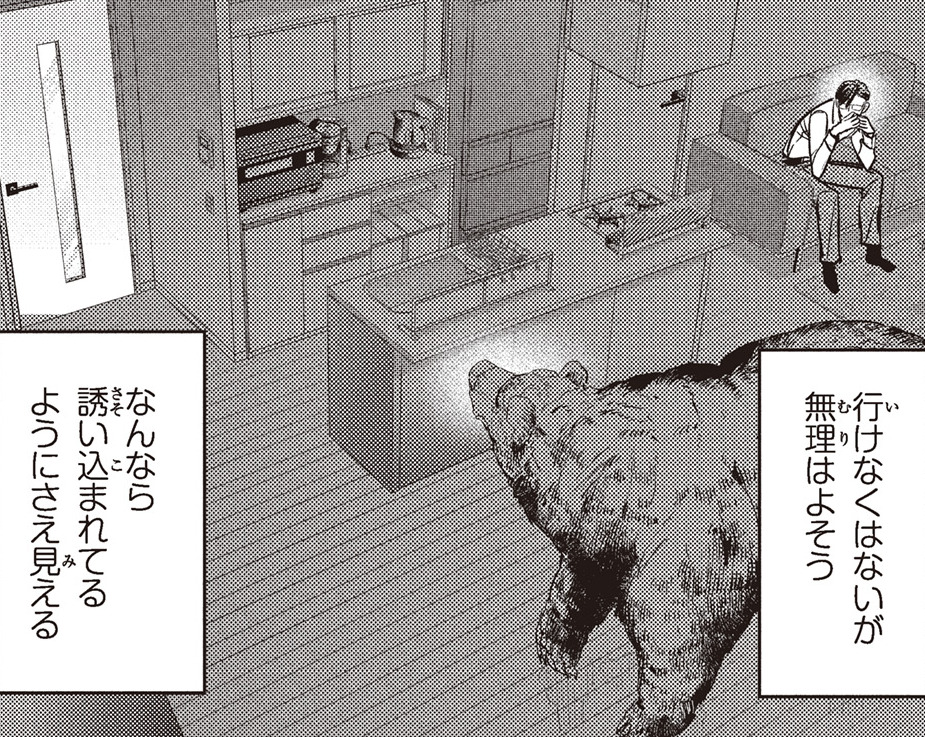
Kumada comes home from work to find a huge, very real bear in his apartment. A cup of coffee doesn’t calm him down. He tells himself to sort out the situation, admits he knows nothing about bears and has no physical strength to speak of, and resolves to raise his odds of survival. His first concern is an escape route.
- 熊田:
- 「行けなくはないが無理はよそう」
- “I could make it, but let's not push my luck.”
- 「なんなら誘い込まれてるようにさえ見える」
- “If anything, it even looks like I'm being lured in.”
Key Points
- さえ means “even”. It points to an extreme case, beyond what you’d expect.
- Without it, 誘い込まれてるように見える is a plain impression, “it looks like I’m being lured in”. With さえ, Kumada flags that impression as the extreme one. He’s gone from “risky” all the way to “trap”.
- さえ replaces が and を, but other particles stay in front of it. Here it follows the に of ように, giving ようにさえ.
- なんなら is a casual “if anything” or “you could even say”. It warns that the speaker is about to take the point a step further.
- It pairs well with さえ. なんなら opens the step up, and さえ marks the extreme it lands on.
- 誘い込む combines 誘う, “invite”, with 込む, “into”. It means to lure someone into a place or a trap.
- 誘い込まれる is the passive, “be lured in”. まれてる is the casual contraction of まれている, with the い dropped.
- 行けなくはない puts the negative 行けない, “can’t go”, inside another negative: “it’s not that I can’t go”. The double negative makes it a reluctant yes.
- よそう is the volitional form of よす, “quit” or “refrain”. 無理はよそう is “let’s not overdo it”, said to himself. Together the line means he could probably make it but won’t risk it.
Vocabulary
行く (To go)
行く means to go or move toward a place away from the speaker.
無理 (Impossible)
無理 means impossible, unreasonable, or too demanding. In conversation, it can mean “that’s impossible” or warn someone not to push too hard.
よす (To stop; to refrain)
よす means to stop doing something or to decide against it. It is often written in kana and is common in casual speech. The volitional よそう means “let’s not”, and the command よせ means “cut it out”.
なんなら (If anything; if you like)
なんなら takes a statement one step further: “if anything” or “you could even say”. It can also offer an alternative, “if you like” or “if it suits you”: なんなら手伝うよ, “I can help, if you want”.
誘い込む (To lure in)
誘い込む is to lure or tempt someone into a place, a trap, or a group.
見える (To be visible)
見える is for something to be seen. It also means to seem or look a certain way.
See Also
- Grammar: Even and as long as with 〜さえ
- Grammar: Receptive verbs with 〜れる
- Grammar: Volitional with 〜う・〜よう
- Grammar: How casual contractions work
- Kanji: Absence and nothingness with 無
- Kanji: Going and carrying out with 行
- Kanji: Seeing and viewpoints with 見