Every kitchen knife sharpened with 包丁を研ぐ
Vocabulary Explanation: Collocations for cooking
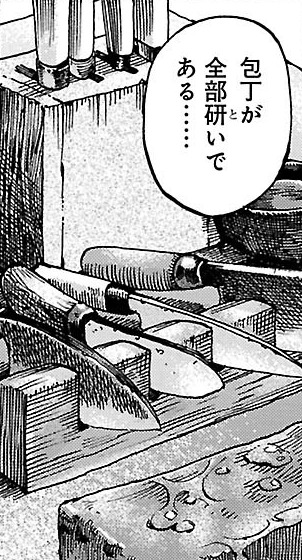
Hakumei is helping the crew repairing the town’s stone walls by washing and sharpening their tools. She stays up all night making them a chart and shows up exhausted, so Iwashi sends her home to sleep. She promises to sharpen twice as much tomorrow. Later, Mikochi comes home and finds Hakumei asleep in bed.
- ミコチ:
- 「包丁が全部研いである……」
- “All the knives have been sharpened…”
Key Points
1包丁を研ぐ = to sharpen a kitchen knife
- 研ぐ means to sharpen a blade by rubbing it on a whetstone, a 砥石. One lies wet in the front of the panel.
- The same verb goes with rice: 米を研ぐ means to wash rice by rubbing the grains together in water. With a knife it always means sharpening.
- Sharpening, 研ぎ, is Hakumei’s job at the work site. When she left, she promised 明日は倍研ぐからな, “I’ll sharpen twice as much tomorrow.”
2研いである = has been sharpened
- 〜てある follows a transitive verb and describes the state that someone’s deliberate action left behind. The person who did it goes unnamed.
- The object of the action takes が here: 包丁が研いである. Mikochi describes what she sees, the knives in their sharpened state.
- Compare 研いでいる, which would mean someone is sharpening them now.
- 研ぐ ends in ぐ, so its て-form is 研いで, like 泳ぐ and 泳いで.
3包丁が全部 = all the knives
- Words of quantity often come after the noun and its particle rather than before it. 包丁が全部研いである means all the knives have been sharpened.
Vocabulary
包丁 (Kitchen knife)
包丁 is the knife used for cooking. Kinds are named by what they cut, such as a 出刃包丁 for fish.
全部 (Whole)
全部 means everything or the whole, with nothing left out.
研ぐ (To sharpen)
研ぐ is to sharpen a blade by rubbing it on a whetstone, as in 包丁を研ぐ. With rice, it means to wash the grains by rubbing them together in water: 米を研ぐ.
See Also
- Vocabulary: Collocations for cooking
- Future entry: Transitivity in Japanese
- Grammar: Doing in advance with 〜ておく
- Kanji: Sections and departments with 部
- Kanji: Wholeness and completion with 全
ハクメイとミコチ © its respective creators. It is used here for educational commentary.