Everyone brushes their teeth with 誰だって
Grammar Explanation: Anyone and always with 誰だって and いつだって
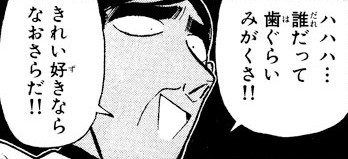
Novelist Imatake has been shot in his hotel room. His old friend Sasai, who shared the room, insists a robber shot Imatake the moment he opened the door to a knock. Conan has learned from Sasai that Imatake was tidy, and now points out toothpaste on the dead man’s mouth and a toothbrush lying beside him. He concludes that Imatake must have been brushing his teeth just before he was shot.
- 笹井:
- 「ハハハ…誰だって歯ぐらいみがくさ!!」
- “Ha ha ha... Everybody brushes their teeth!!”
- 「きれい好きならなおさらだ!!」
- “All the more if you're a neat freak!!”
Key Points
- Here 誰だって means “everybody”. The question word 誰, “who”, with だって covers every person you could name.
- It works like 誰でも, but it’s more casual and stronger. Sasai uses it to make brushing your teeth sound completely normal, so Conan’s clue looks like nothing.
- ぐらい after 歯 marks brushing your teeth as a minimal, ordinary act: “brushing your teeth, at the very least”.
- The nuance is that it’s too ordinary to mean anything. Sasai is saying, “Of course he brushed his teeth. Who doesn’t?”
- みがく is 磨く, “to polish” or “to brush”, written here in kana.
- Sentence-final さ states something as obvious in a casual, offhand way. With the laugh before it, Sasai sounds dismissive.
- きれい好き describes someone who likes things clean and tidy. なら sets it up as a condition: “if someone is a neat freak”.
- なおさら means “all the more” or “even more so”. A tidy person would be even more likely to brush their teeth.
Vocabulary
誰だって (Anyone)
誰だって means anyone or everyone. It’s a casual, stronger version of 誰でも. With a negative, it means nobody.
歯 (Tooth)
歯 is a tooth. It also names tooth-like parts, such as the teeth of a comb, saw, or gear.
みがく (To polish)
みがく is to polish or scrub something until it is clean or shiny, as in 歯をみがく, “to brush your teeth”. It also means to hone a skill. It is often written 磨く.
きれい好き (Neat)
きれい好き describes a person who likes to keep themselves and their surroundings clean and tidy.
なおさら (All the more)
なおさら means all the more or even more so. It says something already true applies even more strongly in another case. It is also written 尚更.
See Also
- Grammar: Anyone and always with 誰だって and いつだって
- Grammar: Casual emphasis with さ
- Grammar: If that's the case with なら
- Grammar: The copula だ