Excited now that the day is here with いざ当日になってみると
Grammar Explanation: When the time comes with いざ〜となると
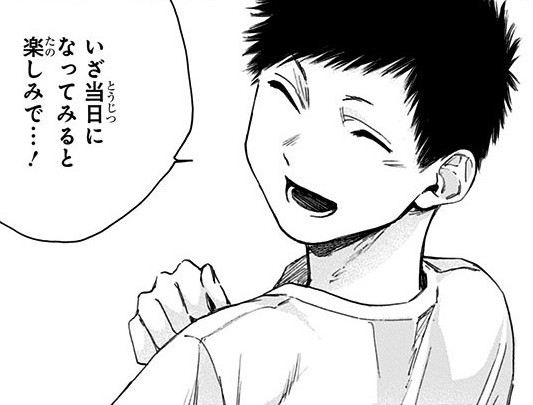
The badminton tournament Taiki has been training for starts today. Chinatsu, who lives at his family’s house, gets up early and finds him already outside doing radio calisthenics. He tells her he couldn’t sit still, and that he thought he’d be tense and stiff with nerves.
- 大喜:
- 「いざ当日になってみると楽しみで…!」
- “But now that the day's actually here, I'm excited...!”
- Literal: “When (I) actually tried becoming the day itself, (it's) something to look forward to, and...!”
Key Points
- いざ stresses that the day is real now, not something he pictures from a distance. Before, he imagined being stiff with nerves. On the day itself, he finds something else.
- なってみる doesn’t mean “try to become”. After a change like 当日になる, 〜てみる means going through it and seeing what it’s like. と then introduces what he found: he’s excited.
- Compare いざ当日となると, “when it actually comes to the day”. That looks at the day as it approaches. Taiki is already in it, so てみると fits.
- 当日 means the day an event happens, here the first day of the tournament. It’s set against the days before, when he could only imagine how he’d feel.
- 楽しみ is a noun, “something to look forward to”, so で is the て-form of the copula. It gives a reason and lets the sentence trail off.
- The unsaid rest points back to what he told Chinatsu a moment ago: he’s so excited that he couldn’t sit still.
Vocabulary
いざ (Actually, for real)
いざ marks the moment something stops being a plan and has to be done for real, as in いざ買うとなると, “when it actually comes to buying”. On its own, it’s an old-fashioned “Now then!” said before starting something.
当日 (The day itself)
当日 is the day a planned event takes place, as opposed to the days before or after it.
なる (To become)
なる is to change into a different state or become something. It also means something turns out a certain way. It is also written 成る.
みる (To see)
みる is the kana spelling of 見る, “to see”. After a て-form verb, it means to try doing something to see how it goes.
楽しみ (Something to look forward to)
楽しみ is something you enjoy or look forward to. 楽しみにする means to look forward to it.
See Also
- Grammar: When the time comes with いざ〜となると
- Grammar: Trying it out with 〜てみる
- Grammar: Natural result with 〜と
- Kanji: Matching and appropriateness with 当