Exploring the neighborhood with 探索
Kanji Explanation: Searching and probing with 探
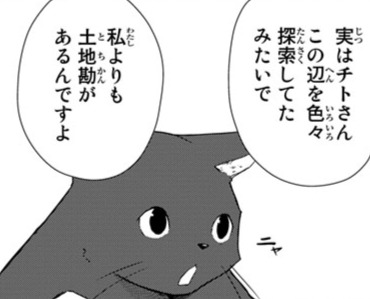
Not long after moving to a new town to stay with relatives, Makoto decides to head out for a walk. Her cousin is worried she’ll get lost. Makoto says not to worry, because she’ll have her witch familiar cat, Chito, with her.
- 真琴:
- 「実はチトさん この辺を色々探索してたみたいで私よりも土地勘があるんですよ」
- “Actually, Chito seems to have explored this area quite a bit, so she knows her way around better than I do.”
- Literal: “Actually, it seems Chito had been searching around this area in various ways, so she has a better feel for the area than I do.”
Key Points
1探索 is being used as a verb here
- 探索してた uses the noun 探索 with する to mean “had been exploring”, not just the noun “exploration”.
- The fuller form is 探索していた; してた is the casual spoken contraction.
2この辺を色々探索してた = explored this area quite a bit
- この辺を marks the area Chito was exploring.
- 色々 adds the sense of in various places, which is why the translation sounds broader than just “explored once”.
3みたいで softens the claim and links it to the result
- みたい means appears, so Makoto is presenting this as her impression rather than a hard statement.
- The で links that idea to what follows: because Chito seems to have explored the area, she knows it better.
4土地勘があるんですよ explains why Makoto is not worried
- 土地勘がある means to have a feel for the area.
- The ending んですよ gives an explanatory, reassuring tone: Makoto is offering this as the reason Chito can guide her.
- さん is an honorific suffix attached to a person’s name to show respect and social distance, roughly equivalent to “Mr.”, “Ms.”, or “Mrs.” in English, though it’s used far more broadly and doesn’t specify gender or marital status.
Vocabulary
探索 (Exploration)
探索 means searching or investigating to find a missing item, unknown information, or a possible solution.
見る (To see)
見る means to see or look at something. It can also mean to examine its condition or nature.
私 (I)
私 means “I” or “me”. It is the standard first-person pronoun in polite speech and is also common in casual speech among women.
土地勘 (Feel for a place)
土地勘 means familiarity with an area and its geography.
See Also
- Kanji: Searching and probing with 探
- Future entry: Past tense with 〜た・〜だ
- Grammar: Reasoning with 〜のだ
- Grammar: Marking the topic with は and も
- Kanji: Earth and places with 地
- Kanji: Privacy and self with 私
ふらいんぐうぃっち © its respective creators. It is used here for educational commentary.