Far from seeing a fish with 〜どころか
Grammar Explanation: Completely opposite to with 〜どころか
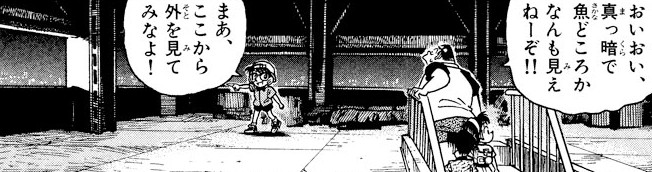
The Detective Boys follow what appears to be an encoded treasure map. They’re able to locate each symbol from the map except for what appears to be a fish. Conan figures it out, and leads the group up a fire escape to the top floor of a nearby building.
- 元太:
- 「おいおい、真っ暗で魚どころかなんも見えねーぞ!!」
- “Hey, it's pitch black. Far from a fish, I can't even see anything!!”
- Literal: “Hey, hey, it's pitch black. Far from fish, I can't see anything!!”
- コナン:
- 「まあ、ここから外を見てみなよ!」
- “Well, try looking outside from here!”
Key Points
- The group was looking for a fish-shaped clue, but Genta says the situation is even worse than that.
- He cannot identify the fish because he cannot see anything at all.
- なんも is a colloquial form of なにも.
- 見えねー is a casual form of 見えない.
Vocabulary
| Word | English | Meaning |
|---|---|---|
| 真っ暗 | Pitch-dark | 真っ暗 describes a place that is completely dark. It also describes a hopeless future. |
| 魚 | Fish | 魚 is a fish. |
| なん | What | なん is the form of なに used before certain sounds, as in なんで and なんなの. It is also written 何. |
| 見える | To be visible | 見える is for something to be seen. It also means to seem or look a certain way. |
| まあ | Well | まあ is a soft “well” that eases into what the speaker says, or accepts something half-heartedly. It also shows mild surprise, like “oh my”. |
| 外 | Outside | 外 is the outside of something, or outdoors. |
| 見る | To see | 見る is to see, look at, or watch something. It also means to check or judge something, or to look after someone, as in 面倒を見る. |
| みる | To see | みる is the kana spelling of 見る, “to see”. After a て-form verb, it means to try doing something to see how it goes. |
See Also
- Grammar: Completely opposite to with 〜どころか
- Grammar: Marking the direct object with を
- Grammar: Negation with 〜ない
- Grammar: Informing with よ
- Grammar: How casual contractions work
- Grammar: Rough declarations with ぞ and ぜ
- Kanji: Seeing and viewpoints with 見