Far too few clues with なさすぎる
Grammar Explanation: Too much with 〜すぎる
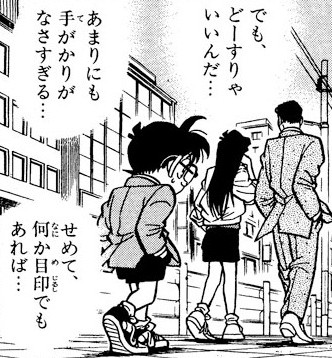
Masami Hirota’s father has been found hanged in his apartment, and the police say it was murder. Masami is missing, and her glasses turned up near the scene. Ran is crushed, and Conan resolves to find Masami before it’s too late.
- コナン:
- 「でも、どーすりゃいいんだ…」
- “But what am I supposed to do...”
- Literal: “But, what would be good if I do...”
- 「あまりにも手がかりがなさすぎる…」
- “There are way too few clues...”
- Literal: “Clues are excessively too nonexistent...”
- 「せめて、何か目印でもあれば…」
- “If only there were some kind of marker, at least...”
- Literal: “At least, if there were something like a marker...”
Key Points
- The adjective ない becomes なさ before すぎる. 手がかりがなさすぎる says the lack of clues goes too far.
- English usually flips this into “too few clues” rather than “too much lack of clues”.
- あまりにも means “far too” or “excessively”. It often comes before すぎる, which also marks excess.
- すれば contracts to すりゃ, and どー is a casual spelling of どう.
- どうすればいいんだ asks “what should I do?” With んだ and no listener, it sounds like Conan asking himself in frustration.
- せめて means “at least”. Conan would settle for even the smallest lead.
- 何か目印でも is “some kind of marker or something”. でも offers it as one example of what would help.
- The ば conditional trails off, leaving the result unsaid: “if there were a marker, (I could find her)”.
Vocabulary
どう (How)
どう asks about the way or state of something: “how” or “how about”. It also appears in どうしよう, “what should I do?”
する (To do)
する is to do or perform something. It also turns many nouns into verbs, as in 勉強する.
いい (Good)
いい describes something good, nice, or fine. It can also mean “okay” or “that’s enough”. Its other forms come from よい, as in よくない and よかった.
あまりにも (Far too)
あまりにも means “far too” or “excessively”. It stresses that something goes well beyond what’s normal or acceptable, and often comes before すぎる.
手がかり (Clue)
手がかり is a clue or lead that helps someone work out what happened or find someone. It can also mean a handhold used for climbing.
ない (Not)
ない means something does not exist or someone does not have it. After a verb, it makes the verb negative. It is also written 無い.
すぎる (Too much)
すぎる follows a verb stem or adjective to mean “too much” or “overly”. On its own, it means to pass by or for time to pass. It is also written 過ぎる.
せめて (At least)
せめて describes the minimum the speaker hopes for, even if more is not possible.
何か (Something)
何か means something or anything. It can also introduce an uncertain question, as in “Is something wrong?”
目印 (Marker)
目印 is a mark or sign that makes something easy to spot or identify, such as a landmark or a tag on a bag.
ある (To exist)
ある is to exist or be in a place, for things and plants rather than people or animals. It also means to have something, or for an event to take place.
See Also
- Grammar: Too much with 〜すぎる
- Grammar: How casual contractions work
- Grammar: Hypothetical condition with 〜ば
- Grammar: Offering an example with 〜でも
- Kanji: Hands and skill with 手