Filling a pot for a double boiler with 鍋に水を張る
Vocabulary Explanation: Collocations for cooking
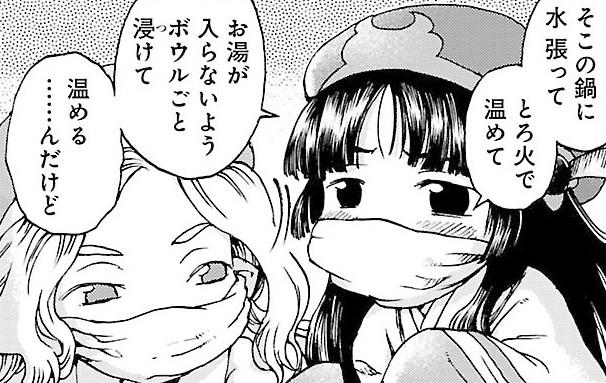
Konju drops by Hakumei and Mikochi’s new house and talks Mikochi into letting her help make honey waffles. Mikochi tells her to whisk the eggs and honey over a double boiler on low heat. Konju asks what a double boiler is, and Mikochi realizes she has to start from the basics.
- ミコチ:
- 「そこの鍋に水張って」
- “Fill that pot there with water.”
- Literal: “Spread water in that pot there.”
- 「とろ火で温めて」
- “Heat it on a low flame.”
- 「お湯が入らないようボウルごと浸けて」
- “Set the whole bowl in it without letting the water get inside.”
- Literal: “Soak it, bowl and all, so that the hot water doesn't go in.”
- 「温める……んだけど」
- “And that warms it… is the idea, anyway.”
- Literal: “(You) warm (it)… is how it goes, but…”
Key Points
- 張る means to stretch or spread something across a surface. With a liquid, it means filling a container so the liquid spreads across it. The container takes に and the liquid takes を: 鍋に水を張る.
- The same phrasing fills a bath, お風呂にお湯を張る, or a sink, シンクに水を張る. 入れる would also work, but 張る suggests filling to a useful depth, not adding a splash.
- Mikochi says 水張って with no を. Casual speech often drops を after a short, obvious object.
- 張って, 温めて, and 浸けて are bare て-forms, 〜てください with ください dropped. Friends give each other step-by-step instructions this way.
- Each て-form is one step, in order: fill the pot, heat it, set the bowl in it.
- とろ火 is the lowest flame. で marks it as the heat the cooking happens on.
- 〜ないよう(に) after a plain negative verb means “so that ~ doesn’t happen”. It gives the purpose of the action that follows: set the bowl in carefully so no water gets in. Mikochi drops the に, which is common in speech.
- 水 turns into お湯 between lines because the water is heated in the meantime. Japanese names cold and hot water with different words.
- ボウルごと means “bowl and all”. 〜ごと says the whole thing goes along, container included, so Konju dips the bowl itself instead of pouring anything into the pot.
- 浸ける means to soak or dip something in liquid.
- んだ presents the line as an explanation, “that’s how you warm it”. けど would normally lead into a second clause, but Mikochi stops there.
- The pause before んだけど and the unfinished けど show her losing confidence midway, as Konju stares at her blankly.
Vocabulary
そこ (There)
そこ points to a place near the listener or one just mentioned. It can also point to a matter just raised, as in そこは “on that point”.
水 (Water)
水 is water, especially cold water.
張る (To stretch)
張る is to stretch or spread something across a space, as with a rope, a tent, or a net. With a liquid, it means to fill a container, as in 鍋に水を張る.
とろ火 (Low flame)
とろ火 is a very low flame on a stove, used to simmer or warm food slowly.
温める (To warm up)
温める is to heat something until it is warm, such as food, a drink, or a room. In casual speech it is often pronounced あっためる.
お湯 (Hot water)
お湯 is heated water. At a hot spring or bath, it also means the bath water itself.
入る (To enter)
入る is to go into a place, or for something to be inside. It also means to join a club or school.
よう (Way)
よう follows a word to show a way or manner, or that something seems a certain way. ようになる means to reach a point where something happens. It is also written 様.
ボウル (Bowl)
ボウル is a deep, round bowl, especially a mixing bowl used in cooking. It is also written ボール.
ごと (And all)
ごと follows a noun to mean that thing included, as in ボウルごと, “bowl and all”. It shows the whole item goes along without being separated or taken out.
浸ける (To soak)
浸ける is to dip or soak something in a liquid. It is pronounced the same as 漬ける, which is used for pickling.
See Also
- Vocabulary: Collocations for cooking
- Grammar: Requests with 〜てください and 〜てくれ
- Grammar: Doing for a reason with 〜ように
- Grammar: But with 〜けど and 〜けれど
- Grammar: Reasoning with 〜のだ
- Grammar: Marking the direct object with を
- Kanji: Entering and putting in with 入