Finished helping somehow with なんとか
Vocabulary Explanation: Something, nothing, and anything with question words
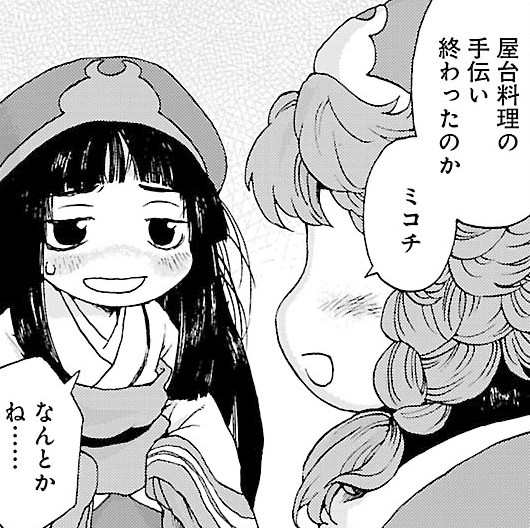
Hakumei is waiting in town. Mikochi joins her and apologizes for being late.
- ハクメイ:
- 「屋台料理の手伝い終わったのか ミコチ」
- “So you're done helping with the stall food, Mikochi?”
- ミコチ:
- 「なんとかね…」
- “Somehow, yeah...”
Key Points
1なんとかね… means “somehow, yeah…”
- なんとか is getting something done one way or another, usually with some struggle. Mikochi leaves off the verb. The full answer is なんとか終わった, “I got it finished somehow”.
- It’s a yes, with a hint that the job wasn’t easy. The trailing … sounds tired, and she’s late.
2Sentence-final ね softens the reply
- A bare なんとか would sound clipped. With ね, it comes out as a relaxed “yeah, somehow”.
3終わったのか checks a guess
- Mikochi has shown up, so Hakumei guesses the job is over. のか asks her to confirm it. It’s a plainer, somewhat masculine form of の?, and it suits Hakumei’s boyish speech.
- The past 終わった is about completion, “are you done?”, not about when it ended.
4手伝い is a noun here
- 屋台料理の手伝い is “help with the stall food”. The の shows that 手伝い is a noun, not the verb stem in a compound like 手伝い終わる.
- Hakumei drops the particle after it. The fuller sentence is 手伝いは終わったのか.
5屋台料理 is food from street stalls
- 屋台 is a food stall, and 料理 is cooking or a dish.
Vocabulary
終わる (To end)
終わる is for something to come to an end. After a verb stem, it means to finish doing it.
なんとか (Somehow)
なんとか describes managing something one way or another. なんとかする means to do something about a problem.
See Also
- Vocabulary: Something, nothing, and anything with question words
- Grammar: Reasoning with 〜のだ
- Grammar: Past tense with 〜た・〜だ
- Grammar: Seeking agreement with ね
ハクメイとミコチ © its respective creators. It is used here for educational commentary.