Finishing her noodles for her with 〜きれない
Grammar Explanation: Unable to finish with 〜きれない (Future entry)
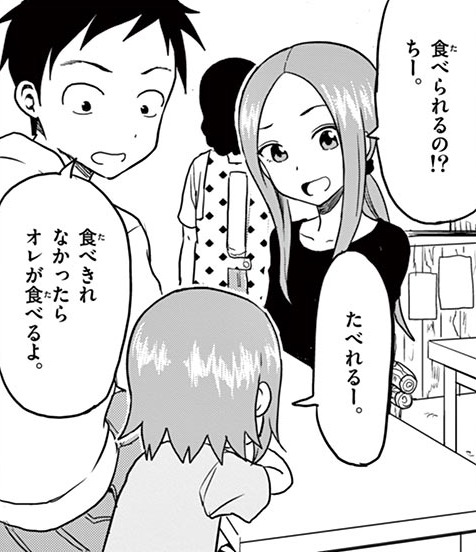
Nishikata, Takagi, and their daughter Chii stop at a restaurant that serves fresh soumen noodles. Nishikata orders a large serving, and Chii asks for a large one too.
- 高木:
- 「食べられるの!? ちー。」
- “You can eat that much, Chii?!”
- ちー:
- 「たべれるー。」
- “I can!”
- 西片:
- 「食べきれなかったらオレが食べるよ。」
- “If you can't finish it, I'll eat the rest.”
Key Points
1食べきれなかったら, “if you can’t finish it”
- 〜きれない after the stem 食べ is about eating all of something. Chii can surely eat some soumen. The question is whether she can get through a whole large serving.
- 食べきれなかった is the past form, and ら makes it 〜たら, “if”. The past form doesn’t mean this already happened. It pictures the moment Chii can’t eat any more.
2食べられる and たべれる vs. 食べきれる
- Takagi asks 食べられるの? with the potential form, “can you eat it?” Chii answers たべれる, a casual potential that drops the ら. Both are about whether she can manage a large serving at all.
- Nishikata’s 〜きれない narrows this down to finishing. He’s ready for the likely outcome: Chii eats part of it and leaves the rest.
3食べられるの!?, a surprised question
- The の turns Takagi’s question into a check on what Chii just said: “You really think you can eat that much?”
4オレが食べるよ
- が marks オレ as the one who will eat, and よ makes the offer sound reassuring: “Don’t worry, I’ll eat it.”
Vocabulary
食べる (To eat)
食べる is to put food in your mouth, chew, and swallow it.
オレ (I)
オレ is a katakana spelling of おれ, a casual, masculine word for “I”. It is also written 俺.
See Also
- Grammar: Able to do with 〜れる・〜られる
- Grammar: If and when with 〜たら
- Grammar: Reasoning with 〜のだ
- Grammar: Marking the subject with が
- Grammar: Informing with よ
- Kanji: Eating and food with 食
からかい上手の(元)高木さん © its respective creators. It is used here for educational commentary.