First to catch five fish wins with 釣る
Kanji Explanation: Fishing and baiting with 釣
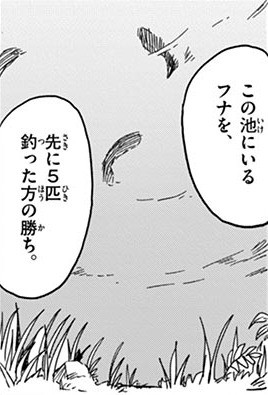
After school, Nishikata leads Takagi to a hidden pond in the woods and hands her a fishing rod and bait. Takagi asks whether today’s contest is a fishing match, and Nishikata says it is. Now he sets the rules.
- 西片:
- 「この池にいるフナを、先に5匹釣った方の勝ち。」
- “Whoever catches five carp from this pond first wins.”
Key Points
- 釣る means to catch a fish with a rod and line. The angler is the subject and the fish takes を: フナを釣る, “catch carp”.
- Compare 釣れる, where the fish is the subject: フナが釣れた, “a carp got caught”. Nishikata uses 釣る because the contest is about what each player does.
- 方 means a side, one of two. 釣った方 is “the one who caught”, and 〜の勝ち is “a win for…”. Together they state a rule: the side that catches five first gets the win.
- The verb is past because the catching comes before the win. English uses the present here: “whoever catches five first wins”.
- この池にいる describes フナ: “the carp that are in this pond”. いる is the verb for living things being somewhere.
- フナ is a crucian carp, a small carp common in Japanese ponds. 5匹 counts them with 匹, the counter for small animals.
- 先に means before the other person. It turns the rule into a race.
Vocabulary
| Word | English | Meaning |
|---|---|---|
| この | This | この means “this” or “these” and comes directly before a noun. It points to something near the speaker or something the speaker is referring to in the conversation. |
| 池 | Pond | 池 is a pond. |
| いる | To be | いる is to exist or be somewhere, for people and animals. After a て-form verb, it shows an ongoing action or a continuing state. |
| フナ | Crucian carp | フナ is the crucian carp, a small freshwater fish of the carp family that is common in Japanese ponds and rivers. |
| 先に | First | 先に means before someone or something else, or ahead of time. 先に行く is “to go on ahead”. |
| 匹 | Counter for small animals | 匹 counts small animals such as fish, cats, dogs, and insects. The number can change its sound, as in 一匹 and 三匹. |
| 釣る | To fish | 釣る is to catch a fish with a hook and line. It also means to lure a person with something they want, as in 餌で釣る. |
| 方 | Side | 方 is a direction or side. In comparisons, 〜方がいい means “it’s better to”. Read かた, it is a polite word for a person. |
| 勝ち | Win | 勝ち is a win or victory. |
See Also
- Kanji: Fishing and baiting with 釣
- Grammar: Marking the direct object with を
- Grammar: Past tense with 〜た・〜だ