Fish bite in the rain with 釣れる
Kanji Explanation: Fishing and baiting with 釣
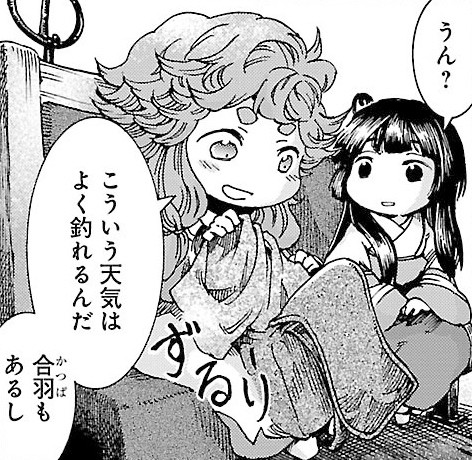
Hakumei and Mikochi take an overnight train to Lake Kanokan, which Hakumei has heard is a great place to fish. Near the end of the trip, it starts to rain. Mikochi says it’s a shame they won’t be able to fish, but Hakumei tells her they’re fishing anyway.
- ミコチ:
- 「うん?」
- “Huh?”
- ハクメイ:
- 「こういう天気はよく釣れるんだ」
- “The fish bite well in weather like this.”
- 「合羽もあるし」
- “And I brought raincoats.”
Key Points
- 釣れる describes fish getting caught, or a spot or time where fishing goes well. よく釣れる is “the fish bite well” or “you catch a lot”.
- With 釣る, someone catches a fish. With 釣れる, the catch just happens, so nobody needs to be named. Here the topic is the weather: こういう天気は, “in this kind of weather”.
- Earlier on the trip Hakumei said the same thing about the lake, カノカン湖はよく釣れるらしい.
- 〜んだ is the casual form of 〜のだ. Hakumei uses it to explain why the rain doesn’t stop her.
- し adds a reason, often after another one. 合羽もあるし is “and besides, I’ve got raincoats”.
- も marks the raincoats as one more thing in Hakumei’s favor. Leaving the sentence on し lets the conclusion, “so we’re fishing”, go unsaid.
- 合羽 is a raincoat or rain cape. The word came into Japanese from Portuguese.
Vocabulary
| Word | English | Meaning |
|---|---|---|
| こういう | This kind of | こういう describes a person or thing like the one being shown or talked about right now. |
| 天気 | Weather | 天気 means weather, such as whether it is sunny, cloudy, or rainy. |
| よく | Often | よく means something happens often. It also means “well” or “skillfully”. Before 〜ね, it can show admiration or surprise. |
| 釣れる | To be caught | 釣れる says that a fish bites and gets caught. よく釣れる describes a good place or day for fishing, and 釣れない means nothing is biting. |
| 合羽 | Raincoat | 合羽 is a raincoat or rain cape worn to keep dry. The word comes from Portuguese, and its kanji were chosen for their sound. |
| ある | To exist | ある is to exist or be in a place, for things and plants rather than people or animals. It also means to have something, or for an event to take place. |
See Also
- Kanji: Fishing and baiting with 釣
- Grammar: Reasoning with 〜のだ
- Grammar: Marking the topic with は and も
- Kanji: Joining and fitting with 合