Fishing is allowed here with 漁
Kanji Explanation: Fishing and catches with 漁
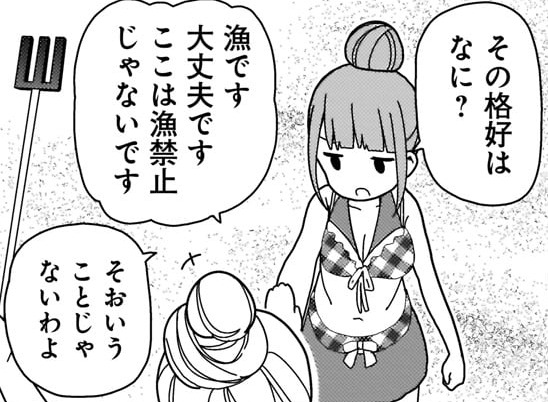
Bocchi and her friends have come to the beach for a day of summer fun. Sotoka arrives in her swimsuit holding a three-pronged spear.
- アル:
- 「その格好はなに?」
- “What's with that getup?”
- ソトカ:
- 「漁です 大丈夫です ここは漁禁止じゃないです」
- “It's for fishing. Don't worry, fishing isn't banned here.”
- アル:
- 「そおいうことじゃないわよ」
- “That's not what I'm asking!”
Key Points
- Here 漁 means fishing, catching fish and other sea life. Sotoka means she plans to spear fish with the trident she brought.
- On its own, 漁 is read りょう. Many compounds read it ぎょ, as in 漁村 and 漁業, while 漁師 keeps りょう.
- 漁 is fishing for a catch, the kind a fisherman does. Fishing with a rod as a hobby is usually 釣り.
- 禁止 means prohibition. After a noun it names a ban on that activity, as on signs: 遊泳禁止, no swimming, and 駐車禁止, no parking.
- ここは漁禁止じゃないです says this spot is not a no-fishing area. じゃないです is a polite way to negate a noun.
- Sotoka answers in three short polite sentences. 漁です names what the getup is for, and 大丈夫です tells Aru not to worry.
- Aru’s casual なに? asks what the outfit is supposed to be, and Sotoka answers a question about rules she was never asked.
- そおいう is そういう spelled the way it sounds. This series often writes お for a long お sound, as in そお and どお.
- そういうことじゃない means “that’s not the point”. Aru wasn’t worried about the rules. She wanted to know why Sotoka brought a spear.
- わよ is a feminine ending that adds force. It makes Aru’s correction sound exasperated.
Vocabulary
| Word | English | Meaning |
|---|---|---|
| その | That | その points to something near the listener or to something just mentioned. Said alone, it fills a pause, like “um”. |
| 格好 | Appearance | 格好 is the way someone looks or is dressed. 格好をする means to dress a certain way. It can also mean posture, or something being suitable. |
| なに | What | なに asks what something is. Said alone, it shows surprise or annoyance: “what?” It is also written 何. |
| 漁 | Fishing | 漁 is fishing for a catch of fish, shellfish, or seaweed, the work fishermen do. It can also mean the catch itself. |
| 大丈夫 | All right | 大丈夫 describes being all right, with nothing to worry about. People use it to reassure others, or to politely say “no thanks”. |
| ここ | Here | ここ is the place where the speaker is. |
| 禁止 | Prohibition | 禁止 is a rule that something must not be done. |
| そういう | That kind of | そういう describes something like the thing just mentioned. |
| こと | Thing | こと is an abstract thing, matter, or fact, as opposed to a physical object. It also turns a verb phrase into a noun, as in 見たことがある. It is also written 事. |
See Also
- Kanji: Fishing and catches with 漁
- Grammar: Polite style with です and ます
- Grammar: Negation with 〜ない
- Grammar: Marking the topic with は and も
- Grammar: Informing with よ