Following after is bad with あかん
Vocabulary Explanation: Vocabulary in the Kansai dialect
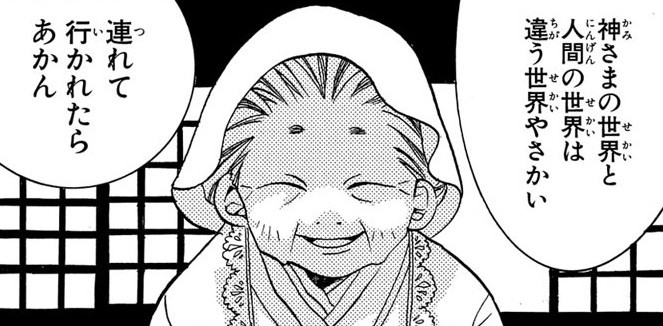
Alicia and Akari visit an island that’s modeled after part of Japan back on Earth. There, an elderly local woman tells the two of the fox spirits that visit the human world there. Akari is excited at the prospect of meeting one, but the old woman gives her a warning: on rare occasion, a fox will take a person back home with them.
- おばあさん:
- 「神さまの世界と人間の世界は違うやさかい」
- “Since the god world and the human world are different...”
- 「連れて行かれたらあかん」
- “...you mustn't get taken away.”
やさかい has a meaning like だから.
Key Points
- In Kansai-flavored speech, あかん often means “that is bad”, “don’t”, or “you mustn’t” rather than just “bad” as an adjective.
- 連れて行かれたら means “if you get taken away”.
- The speaker is not talking about Akari choosing to go, but about being carried off by the fox.
- やさかい works like だから / だからこそ here and links the explanation to the warning that follows.
- The full flow is “the god world and human world are different, so you must not be taken there.”
Vocabulary
| Word | English | Meaning |
|---|---|---|
| 神さま | God | 神さま is a god or God, said with respect. It is also written 神様. |
| 世界 | World | 世界 is the world and the people in it. It also means a particular sphere, such as the world of art. |
| 人間 | Human being | 人間 means a human being or humanity. It can also refer to someone’s character or personality. |
| 違う | To differ | 違う is to be different from something. It also means to be wrong. |
| 連れて行く | To take along | 連れて行く is to take someone with you when you go somewhere. |
See Also
- Vocabulary: Vocabulary in the Kansai dialect
- Grammar: Marking the topic with は and も
- Grammar: If and when with 〜たら
- Grammar: Receptive verbs with 〜れる
- Grammar: Coming and going with 〜てくる and 〜ていく
- Kanji: Boundaries and worlds with 界
- Kanji: Going and carrying out with 行
- Kanji: Linking and succession with 連
- Kanji: People and persons with 人
- Kanji: Spaces and intervals with 間