Following the codes to something with 〜ってわけだ
Grammar Explanation: Logical conclusion with 〜わけだ
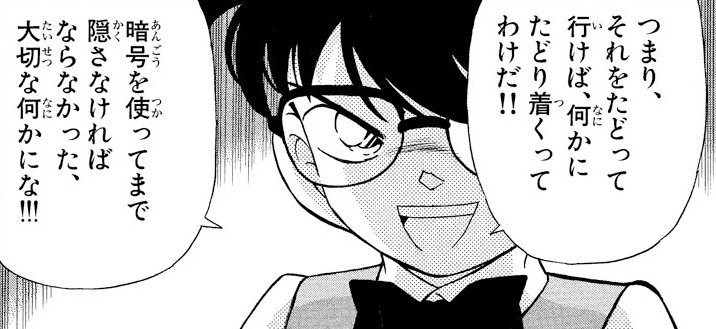
Professor Agasa set up a treasure hunt for the Detective Boys at his late uncle’s villa, but an intruder got there first and slashed the hidden toys. The children found codes of suns, moons, and stars drawn on objects all around the villa. Conan worked out that the symbols stand for hiragana and decoded two of them as “Look at the propeller” and “Look at the oil painting”.
- コナン:
- 「つまり、それをたどって行けば、何かにたどり着くってわけだ!!」
- “So if we follow them, we'll get to something, that's what it means!!”
- コナン:
- 「暗号を使ってまで隠さなければならなかった、大切な何かにな!!!」
- “Something important, important enough that it had to be hidden with codes!!!”
Key Points
- わけだ presents a statement as following from facts already in hand. Here the fact is the pattern Conan has just found: each code tells you to look at another object.
- The condition 行けば sets up the result, and わけだ states what has to follow: 何かにたどり着く. ことになる could replace わけだ here.
- って is the casual form of という. ってわけだ wraps up his chain of reasoning in a single statement, and つまり at the start signals that conclusion.
- たどる means to follow something along, such as a road, a trail, or a set of clues. 〜て行く adds movement onward, from one code to the next.
- たどり着く means to finally reach a destination after following a path. The two verbs share たどり, so the line moves from following to arriving.
- The second balloon finishes the first. 大切な何かに restates the 何かに from 〜にたどり着く with more detail, and な adds Conan’s emphasis.
- In normal order it would be 大切な何かにたどり着く. Speakers often tack on a fuller version of a phrase after the main sentence.
- 〜てまで means “even going so far as to”. Using codes is an extreme step, and it shows how badly someone wanted the thing hidden.
- 隠さなければならなかった is the past of 〜なければならない, “had to hide”. The whole clause describes the 何か: something that had to be hidden, even with codes.
Vocabulary
つまり (In other words)
つまり introduces a restatement or conclusion of what was just said: “in other words”, “in short”, “so”. It often comes before a sentence ending in わけだ or ということだ.
それ (That)
それ points to something near the listener, or to something just mentioned.
たどる (To follow)
たどる means to follow something along its course, such as a road, tracks, or a trail of clues. It’s also used for tracing a memory or history back step by step. It is also written 辿る.
行く (To go)
行く means to go or move toward a place away from the speaker.
何か (Something)
何か means something or anything. It can also introduce an uncertain question, as in “Is something wrong?”
たどり着く (To finally reach)
たどり着く means to reach a destination at last, after following a long or uncertain way.
わけ (Reason)
わけ is a reason or meaning. It also appears in grammar patterns such as わけがない, “there’s no way”, and わけにはいかない, “can’t very well”.
使う (To use)
使う is to use something as a tool or means. It also means to spend money or time.
隠す (To hide)
隠す means to put something where others can’t see or find it, or to keep a fact or feeling secret.
なる (To become)
なる is to change into a different state or become something. It also means something turns out a certain way. It is also written 成る.
See Also
- Grammar: Logical conclusion with 〜わけだ
- Grammar: Hypothetical condition with 〜ば
- Grammar: Must do with 〜なければならない
- Kanji: Going and carrying out with 行