Forgotten homework with 宿題
Kanji Explanation: Topics and assigned problems with 題
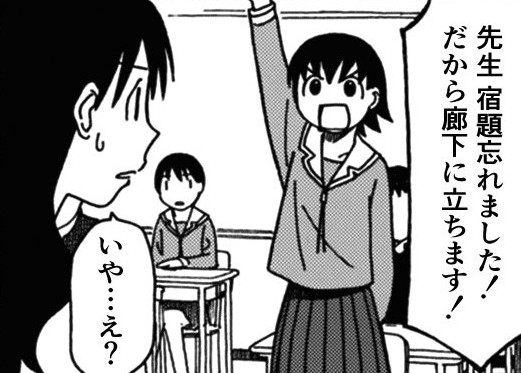
Tomo stands from her desk and raises her hand.
- とも:
- 「先生 宿題忘れました!だから廊下に立ちます!」
- “Teacher, I forgot my homework! So I'll stand in the hall!”
- Literal: “Teacher, I forgot the homework! Therefore I'll stand in the hallway!”
Key Points
1宿題 = “homework”
- Here, 宿題 is the work the teacher assigned for students to complete outside class.
- In this compound, 題 contributes “topic”. 宿 suggests something that remains, fitting a task carried away to finish later.
2Casual particle omission: 宿題(を)忘れました
- The object marker を is left out. The full form is 宿題を忘れました, “I forgot my homework.”
- Japanese does not need a word for “my” here. The situation makes it clear whose homework Tomo forgot.
3だから introduces Tomo’s conclusion
- At the start of the second sentence, だから means “so” or “therefore”. It presents standing in the hall as the consequence of forgetting her homework.
4廊下に立ちます = “I’ll stand in the hall”
- With 立つ, に marks the place where someone takes up a standing position.
Vocabulary
先生 (Teacher)
先生 is a respectful title for teachers and certain professionals, including doctors, lawyers, and politicians. Speakers do not normally use it for themselves.
廊下 (Hallway)
廊下 means a corridor or hallway connecting rooms in a building.
See Also
- Kanji: Topics and assigned problems with 題
- Grammar: Marking the direct object with を
- Future entry: Because with 〜から
- Future entry: Past tense with 〜た・〜だ
- Grammar: Polite style with です and ます
- Kanji: Below and lowering with 下
あずまんが大王 © its respective creators. It is used here for educational commentary.