Getting bored easily with 〜っぽい
Grammar Explanation: Kind of like with 〜っぽい
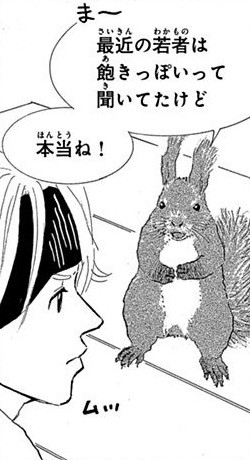
Masaki is training as a coffee roaster, but so far the work is sorting coffee beans by hand alongside the squirrels at the roastery. He slides in just in time again this morning, and soon after they start sorting, he grumbles that it’s nothing but hand-picking every day.
- エゾリス:
- 「ま〜 最近の若者は飽きっぽいって聞いてたけど 本当ね!」
- “Well, I'd heard young people these days get bored easily, and it's true!”
Key Points
- 飽きっぽい is the stem of 飽きる, “to get tired of something”, plus っぽい. It describes someone who gets bored of things quickly.
- Masaki’s 飽きた is one event, “I’m sick of it”. 飽きっぽい is a trait, and the squirrel uses his complaint as evidence of it.
- It’s a criticism, like most っぽい words made from verbs.
- って is the casual quotation marker, standing in for と. It marks 最近の若者は飽きっぽい as what she heard.
- 聞いてた is 聞いていた, with the い dropped in casual speech. It’s “had heard”, something she knew before meeting Masaki.
- けど links the rumor to her conclusion: “I’d heard that, and…” Here it sets up the next part rather than contrasting with it.
- 本当ね is “it’s true, isn’t it”. ね invites agreement, though Masaki is the last one who wants to agree.
- 最近の若者 is “young people these days”, the usual phrase for complaining about the younger generation.
Vocabulary
若者 (Young person)
若者 means a young person or young people as a group.
飽きっぽい (Quick to lose interest)
飽きっぽい describes someone who gets bored of things quickly and doesn’t stick with them.
飽きる (To get tired of)
飽きる is to lose interest in something after having too much of it, to get bored of it or sick of it.
っぽい (-ish)
っぽい follows a word to say something seems like it or tends toward it.
聞く (To hear)
聞く is to hear or listen to something. It also means to ask a question.
本当 (Truth)
本当 is the truth, as opposed to a lie or a joke. ほんとう? asks “really?”
See Also
- Grammar: Kind of like with 〜っぽい
- Grammar: Quoting and reporting with と and って
- Grammar: Ongoing actions and resulting states with 〜ている
- Grammar: But with 〜けど and 〜けれど
- Grammar: Seeking agreement with ね
- Kanji: Matching and appropriateness with 当
- Kanji: Origins and main things with 本