Getting onto a subway car with 飲み込む
Vocabulary Explanation: Words ending in 込む
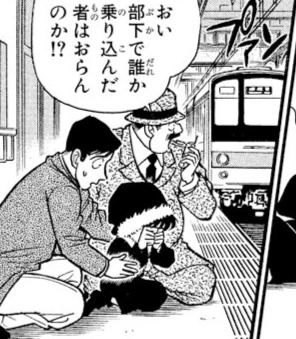
Following the kidnapping of a pop music duo, the police are forced to rely on Conan and his friends to deliver the ransom. The kids speak to one of the kidnappers by phone at the subway station, with the police force watching from a distance. When a subway car is about to close its doors, the kids suddenly bolt onto the nearest car, three of the four making it on before the doors close.
- 目暮:
- 「おい部下で誰か乗り込んだ者はおらんのか!?」
- “Hey! Did any of you get on?!”
- Literal: “Hey, is there no one among the subordinates who boarded!?”
Key Points
- 乗る means “to get in”, and 込む indicates movement into a space.
- Read 乗り込んだ before 者 as “a person who got on”.
- Megure uses 部下で to set the group and 誰か to ask whether anyone in that group boarded.
- おらん is the negative form of おる. Megure uses it for a blunt, older-sounding voice; a neutral version would use いない.
- のか turns the clause into a pointed question. Megure’s negative wording makes the same demand as the translation’s “Did any of you get on?”
Vocabulary
| Word | English | Meaning |
|---|---|---|
| 部下 | Subordinate | 部下 is a person who works under someone in an organization. |
| 誰か | Someone | 誰か is some person who is not named or not known. |
| 乗り込む | To board | 乗り込む is to get on or into a vehicle. It also means to march into a place to confront someone. |
| 者 | Person | 者 is a person. It is a formal or rough word, as in 部下の者, “one of my men”. |
| おる | To be | おる is a humble or polite form of いる. In western Japanese dialects, it is the everyday word for いる, and after a て-form verb it shows an ongoing action. |
See Also
- Vocabulary: Words ending in 込む
- Grammar: Past tense with 〜た・〜だ
- Grammar: Negation with 〜ない
- Kanji: Below and lowering with 下
- Kanji: Sections and departments with 部