Getting pranked with 〜っぽい
Grammar Explanation: Kind of like with 〜っぽい
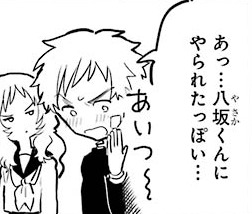
Mie has forgotten her glasses again, and at lunch she squints at the tiny print on a sticker from her bread bag. When Komura comes over to see what’s wrong, she notices something on his face and asks whether there’s something stuck to his cheek.
- 小村:
- 「あっ…八坂くんにやられたっぽい…」
- “Oh... Looks like Yasaka got me...”
- 小村:
- 「あいつ〜」
- “That guy...”
Key Points
1A guess with clause + っぽい
- 八坂くんにやられた is a whole clause, and っぽい after it makes a guess, “looks like” or “seems”. It’s a casual way to say みたい.
- The past tense た sits inside the clause, before っぽい, because the guess is about something that already happened. A っぽい word takes its tense after っぽい instead, as in 子供っぽかった.
- Komura didn’t feel the sticker go on, so he can only guess. He’s pretty sure who did it, though.
2八坂くんにやられた, “Yasaka got me”
- やられる is the receptive of やる, “to do”. In casual speech, やられた means something was done to you, from being beaten to being tricked. Here it’s a prank.
- With a receptive verb, に marks the one who did it. Komura is the one it happened to.
3あいつ〜
- あいつ is a rough, familiar “that guy”. With the stretched 〜, Komura sounds more exasperated than angry.
Vocabulary
やる (To do)
やる is a casual word for “to do”. It also means to give something to someone of lower standing, or to animals and plants.
っぽい (-ish)
っぽい follows a word to say something seems like it or tends toward it.
あいつ (That guy)
あいつ refers to a person who is not part of the conversation, or sometimes to a thing. It is casual and can sound rough or familiar.
See Also
- Grammar: Kind of like with 〜っぽい
- Grammar: Receptive verbs with 〜れる
好きな子がめがねを忘れた © its respective creators. It is used here for educational commentary.