Ginger grated for karaage with すりおろす
Vocabulary Explanation: Collocations for cooking
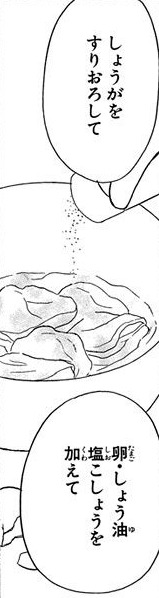
Miku has almost no confidence in her cooking, but after a classmate showed off a homemade boxed lunch from his girlfriend, she offered to make one for Shibuya, and he was thrilled. Now she’s in the kitchen with a boxed lunch cookbook. With the eggs on to boil, she decides to make karaage and reads the recipe aloud as she goes, starting with cutting the chicken into bite-sized pieces.
- みく:
- 「しょうがをすりおろして」
- “Grate the ginger,”
- 「卵・しょう油 塩こしょうを加えて」
- “add the egg, soy sauce, and salt and pepper...”
Key Points
- すりおろす means to grate food on a grater. It combines する (to rub) and おろす (to grate), and the food takes を: しょうがをすりおろす, リンゴをすりおろす.
- Grated ginger goes into the soy sauce marinade for Japanese fried chicken. The grater is an おろし金.
- Recipes write each step in the plain dictionary form, like the 「鶏肉はひと口大に切る」 Miku read in the panel before. The て-form joins steps in order: grate the ginger, then add the egg and seasonings.
- Both of Miku’s lines end in て, and the chain continues in the next panel with 片栗粉を加えてよくもみこむ, “add potato starch and knead it in well”.
- 加える means to add something to what’s already there. In recipes, 〜を加える is the standard way to add an ingredient.
- The dot ・ separates items in a list, like a comma. In the balloon, a line break separates しょう油 and 塩こしょう instead.
- しょう油 is soy sauce. Its full kanji spelling is 醤油, but 醤 is a rare kanji, so the word is often written with kana for the first half. 塩こしょう is salt and pepper, treated as a single seasoning.
Vocabulary
しょうが (Ginger)
しょうが is ginger, a spicy root used in Japanese cooking. It is usually grated or sliced thin, and pickled ginger comes with sushi.
すりおろす (To grate)
すりおろす is to rub food against a grater until it turns into pulp, as with ginger, daikon, or apple.
卵 (Egg)
卵 is an egg, especially a chicken egg used as food. It also means a person still in training, as in 医者の卵, a future doctor.
しょう油 (Soy sauce)
しょう油 is soy sauce, a common way of writing 醤油 that replaces the rare kanji 醤 with kana.
塩こしょう (Salt and pepper)
塩こしょう is salt and pepper treated as one seasoning, or seasoning food with both.
加える (To add)
加える is to add something to what is already there, such as an ingredient to a dish or a member to a group.
See Also
- Vocabulary: Collocations for cooking
- Grammar: Connecting actions with 〜て・〜で