Giving up catching a cat with 匙を投げる
Idiom Explanation: Giving up with 匙を投げる
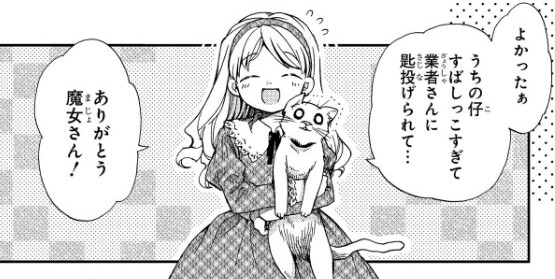
Eve takes the job of catching a cat that ran away from its owner. Following a successful mid-air catch off the roof and into a tree, Eve returns the cat to its owner.
- お城ちゃん:
- 「よかったぁ うちの仔すばしっこすぎて業者さんに匙投げられて…」
- “Thank goodness! Our little one was so quick that the hired help gave up on us...”
- Literal: “Thank goodness. Our little one was so quick that the hired help threw the spoon...”
- 「ありがとう 魔女さん」
- “Thank you, Miss Mage.”
Key Points
- The hired help abandoned the job because the cat was too quick.
- The idiom is figurative; no spoon is actually being thrown in the scene.
- 投げる becomes the receptive 投げられる, whose て-form is 投げられて. The professionals gave up, and the owner was left without their help.
- 業者さんに identifies the professionals as the people who gave up. The owner is the person affected.
- The spoken line leaves out を from 匙を投げられて, giving 匙投げられて.
- すばしっこい means nimble or quick.
- 〜すぎて says the cat was too quick, leading to the hired help giving up.
Vocabulary
うち (I)
うち can mean “I” or “me”, especially in Kansai speech and in casual speech among women. It also has other meanings, including “home” and “inside”.
仔 (Young animal)
仔 is a young animal, like a cub or pup. Pet owners also use it for their pets.
すばしっこい (Nimble)
すばしっこい describes someone or something that moves very quickly and is hard to catch.
業者 (Contractor)
業者 means a business, contractor, supplier, or dealer. The best English term depends on the service or trade involved.
匙を投げる (To give up)
匙を投げる is to give up on something as hopeless. The picture is a doctor throwing down the spoon used to mix medicine.
魔女 (Witch)
魔女 means a witch, a woman believed to use magic or sorcery.
See Also
- Idiom: Giving up with 匙を投げる
- Grammar: Past tense with 〜た・〜だ
- Grammar: Too much with 〜すぎる
- Grammar: Receptive verbs with 〜れる
- Grammar: Marking the direct object with を
- Kanji: Women and femininity with 女
- Kanji: Work and vocation with 業