Good enough for his senpai with 釣り合う
Kanji Explanation: Fishing and baiting with 釣
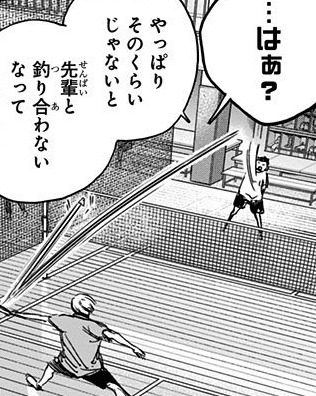
Chinatsu turned down moving abroad with her parents so she could stay in Japan and aim for the Inter-High in basketball. She now lives with Taiki’s family. During badminton practice, Kyo tells Taiki he’s lucky to be living with the girl he likes and might even end up dating her. Taiki says he can’t just ask her out after seeing that kind of resolve, so he has decided to aim for the Inter-High himself this summer.
- 匡:
- 「…はぁ?」
- “...Huh?”
- 大喜:
- 「やっぱりそのくらいじゃないと先輩と釣り合わないなって」
- “I figured I'd need at least that much to be good enough for her.”
Key Points
- 釣り合う means to balance. The image is a hanging scale, with the same weight on each side. With people, AとBが釣り合う means A and B suit each other or stand on equal footing.
- 先輩と釣り合わない is “not a match for her”. People say it about couples where one side seems to outclass the other.
- Here 釣 is about weights hanging on a scale, not about fishing. The noun 不釣り合い, “mismatched”, comes from the same idea.
- そのくらい is “about that much”. It points back to going to the Inter-High.
- じゃないと is the casual form of でないと, “unless it’s”. The bad result follows: unless he reaches that level, he won’t match her.
- Taiki’s line finishes the sentence he started a panel earlier: だから思ったんだよね、俺もこの夏インターハイ行こうって. なって quotes a second thought he had, with な showing he said it to himself.
- やっぱり means “after all” or “when it comes down to it”. It shows he thought it over and reached this conclusion.
Vocabulary
| Word | English | Meaning |
|---|---|---|
| やっぱり | As expected | やっぱり shows that something turned out as the speaker thought, or that the speaker is coming back to an earlier choice: “after all”. |
| その | That | その points to something near the listener or to something just mentioned. Said alone, it fills a pause, like “um”. |
| くらい | About | くらい after a number or amount means “about” or “around”. With は, as in 一人くらいは, it means “at least”. It is also pronounced ぐらい. |
| 先輩 | Senior | 先輩 is a senior member of the same school, workplace, or group, usually someone who joined earlier or has more experience. |
| 釣り合う | To be well matched | 釣り合う is to balance or be in proportion. Said of people, it means they suit each other, and 釣り合わない means one feels out of the other’s league. |
See Also
- Kanji: Fishing and baiting with 釣
- Grammar: Natural result with 〜と
- Grammar: Quoting and reporting with と and って
- Kanji: Joining and fitting with 合