Grating apple into the curry with すりおろす
Vocabulary Explanation: Collocations for cooking
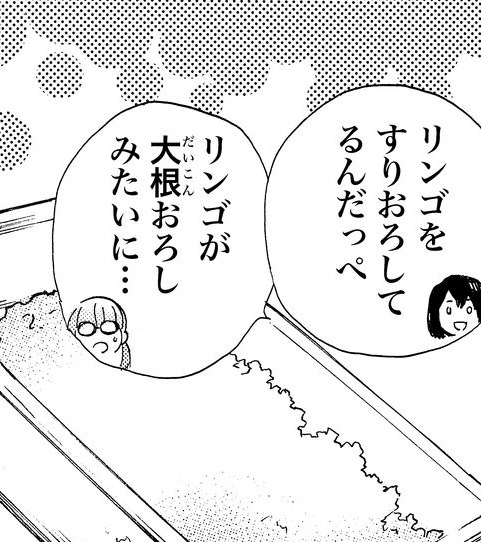
Hinata’s second-grade class is cooking curry on an overnight school trip. Midori has just noticed that the curry roux her team brought is medium-hot, and most of the children are sure it will be too spicy for them. While they argue, Hinata spots an apple among the ingredients and gets to work over a bowl. Midori asks her what she’s doing.
- ひなた:
- 「リンゴをすりおろしてるんだっぺ」
- “I'm grating an apple.”
- 美鳥:
- 「リンゴが大根おろしみたいに…」
- “The apple's all mushy, like grated daikon...”
- Literal: “The apple, like grated daikon...”
Key Points
- すりおろす means to grate food on a grater. It combines する (to rub) and おろす (to grate), and the food takes を: リンゴをすりおろす, しょうがをすりおろす.
- Grated apple is a common secret ingredient in Japanese home curry. It softens the meat and takes the edge off the spice, which is Hinata’s fix for the medium-hot roux.
- おろし is the noun form of おろす, and 大根おろし is grated daikon, served with grilled fish, tempura, and soba. The grater itself is an おろし金.
- 〜みたいに means “like ~”. Midori trails off before saying what the apple became, but the comparison says it all: it looks just like a pile of grated daikon.
- すりおろしてる is the casual contraction of すりおろしている, “am grating”. Spoken Japanese drops the い of ている almost all the time.
- 〜んだ explains a situation, here answering Midori’s question about what Hinata is doing.
- っぺ is a well-known ending of the northern Kanto dialect that Hinata speaks. After んだ, it works like よ, so standard Japanese would say すりおろしてるんだよ.
Vocabulary
リンゴ (Apple)
リンゴ is an apple. It is also written りんご, or 林檎 in kanji.
すりおろす (To grate)
すりおろす is to rub food against a grater until it turns into pulp, as with ginger, daikon, or apple.
大根おろし (Grated daikon)
大根おろし is daikon radish grated into a wet pulp, often served with grilled fish, tempura, or soba. It can also mean the grater used to make it.
みたい (Like)
みたい follows a word to compare something to it: “like” or “similar to”. It also means “it seems”.
See Also
- Vocabulary: Collocations for cooking
- Grammar: Ongoing actions and resulting states with 〜ている
- Grammar: How casual contractions work
- Grammar: Reasoning with 〜のだ
- Grammar: Likening things with 〜みたい