Grocery shopping plan understood with 了解
Kanji Explanation: Separating and understanding with 解
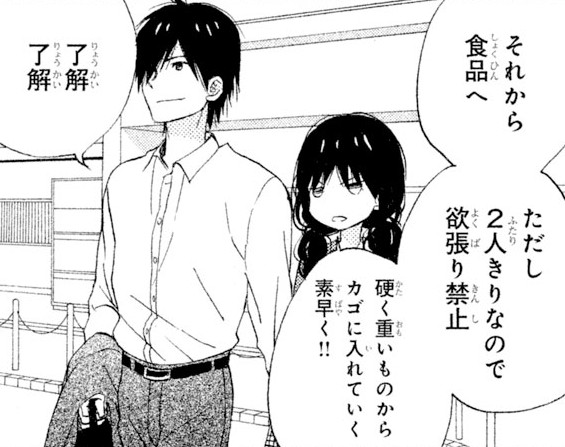
Mao needs Hiro to go grocery shopping with her due to a sale that’s limited per customer. She tells him the plan is to start by grabbing everyday household items first.
- 真魚:
- 「それから食品へ」
- “Then move on to food.”
- 「ただし2人きりなので欲張り禁止」
- “But since it's just the two of us, no hoarding allowed!”
- 「硬く重いものからカゴに入れていく素早く!!」
- “We'll fill the basket as we go, starting with the hard, heavy stuff. Fast!!”
- 基:
- 「了解 了解」
- “Roger that.”
- Literal: “Understood, understood.”
Key Points
- 了解 acknowledges that you have understood instructions, a plan, or a request.
- Hiro repeats it to show he has taken in Mao’s grocery-shopping strategy.
- 〜ていく can describe continuing an action forward from the current point.
- Here Mao wants them to keep putting items into the basket as they go, beginning with hard and heavy things.
Vocabulary
| Word | English | Meaning |
|---|---|---|
| 食品 | Food product | 食品 refers to food as a product, including ingredients and ready-to-eat items. |
| きり | Only | きり follows a word to limit it, as in 二人きり, “just the two of us”. It also marks the last time something happened, as in それきり. |
| 欲張り | Greed | 欲張り is wanting more than one’s share, or a greedy person. |
| 禁止 | Prohibition | 禁止 is a rule that something must not be done. |
| 硬い | Hard | 硬い describes something firm or rigid that does not bend. |
| 重い | Heavy | 重い describes something heavy. It also describes something serious or burdensome. |
| カゴ | Basket | カゴ is a basket, such as a shopping basket. It is also written 籠. |
| 入れる | To put in | 入れる is to put something inside something else. It also means to let someone in, or to make tea or coffee. |
| 素早い | Quick | 素早い describes moving or acting very fast. |
| 了解 | Understanding | 了解 means understanding and accepting what someone has said or requested. |
See Also
- Kanji: Separating and understanding with 解
- Grammar: Compound voicing with 連濁
- Grammar: Coming and going with 〜てくる and 〜ていく
- Kanji: Eating and food with 食
- Kanji: Entering and putting in with 入
- Kanji: Goods and refinement with 品