Had a bad experience in Nara with 〜目に遭う
Idiom Explanation: Having a bad experience with 〜目に遭う
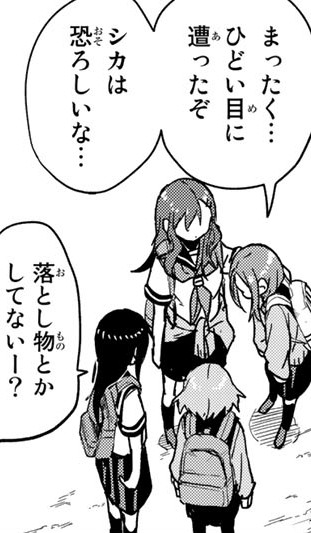
While in Nara on a class trip, Urushi and her friends stop to feed to deer. As the hungry animals completely surround Urushi, her friends discuss their schedule, ignoring Urushi’s plight. When Urushi finally returns to her group, she demands to know why no one came to her rescue.
- うるし:
- 「まったく… ひどい目に遭ったぞ」
- “Seriously… I had a terrible experience.”
- Literal: “Honestly... I met with a terrible experience.”
- 「シカは恐ろしいな…」
- “Deer are scary…”
- ミク:
- 「落とし物とかしてないー?」
- “Did you drop anything?”
Key Points
1ひどい目に遭った means had a terrible experience
- 〜目に遭う means to meet with or suffer through an unpleasant experience.
- The adjective ひどい names what kind of experience it was: awful or harsh.
2目 is not eye in this idiom
- In ひどい目, 目 means an experience or situation someone undergoes.
- The deer incident is the bad thing Urushi “met with”.
3ぞ adds force to Urushi’s complaint
- The ending ぞ makes the statement emphatic and assertive.
- It fits Urushi demanding recognition after her friends failed to rescue her.
4シカは恐ろしいな generalizes the lesson
- After the idiom, Urushi sums up the experience as シカは恐ろしい.
- The な ending gives the line a reflective, muttered feel.
Vocabulary
| Word | English | Meaning |
|---|---|---|
| ひどい | Terrible | ひどい describes something very bad or severe, or someone cruel. Said alone, it complains about unfair treatment: “that’s mean!” |
| 目に遭う | To go through | 目に遭う is to have a bad experience, such as ひどい目に遭う, to have a terrible time. |
| 恐ろしい | Frightening | 恐ろしい describes a state of anxiety or fear caused by a sense of danger or harm, or a situation that is so extreme as to be astonishing. |
| 落とし物 | Lost item | 落とし物 is something someone dropped or lost. |
See Also
- Idiom: Having a bad experience with 〜目に遭う
- Grammar: Past tense with 〜た・〜だ
- Grammar: Marking the topic with は and も
- Grammar: Rough declarations with ぞ and ぜ
- Kanji: Fear and intimidation with 恐
- Kanji: Things and kinds with 物
それでも歩は寄せてくる © its respective creators. It is used here for educational commentary.