Hand-picked Sherlockians with 厳選
Kanji Explanation: Choosing and selection with 選
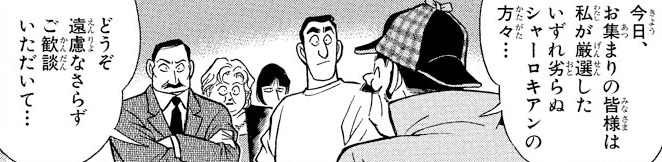
Kogoro, Ran, and Conan have come on a tour for Sherlock Holmes fans that Conan entered without asking. On the drive, the other guests traded talk about their favorite Holmes stories. Now the group has reached Pension Mycroft, where the owner, Kanaya, introduces himself as the man who planned the tour.
- 金谷:
- 「今日、お集まりの皆様は私が厳選したいずれ劣らぬシャーロキアンの方々…」
- “Everyone gathered here today is a Sherlockian I hand-picked, each one as devoted as the next...”
- 「どうぞ遠慮なさらずご歓談いただいて…」
- “Please don't be shy. Enjoy each other's company...”
Key Points
- 厳選 combines 厳, strict, with 選, to choose. It means selecting with high standards so only the best remain.
- Kanaya uses it to compliment his guests. Being 厳選された means you passed a demanding selection.
- The word shows up a lot in advertising, as in 厳選された素材, carefully chosen ingredients.
- The core sentence is 皆様は〜方々, “everyone is ~ people”. Everything between は and 方々 describes the guests.
- 私が厳選した is a relative clause, “whom I carefully selected”. Inside a relative clause, the subject takes が.
- いずれ劣らぬ and シャーロキアンの also modify 方々, so the guests are hand-picked, equally devoted Sherlockians.
- ぬ is an old negative ending that equals ない. 劣らぬ means 劣らない, not inferior.
- いずれ劣らぬ is a set phrase meaning none of them is worse than the others. Kanaya is saying every guest is a first-rate Holmes fan.
- お集まりの皆様 and 方々 are respectful ways to refer to the guests.
- なさらず is the respectful verb なさる plus the negative ず, “without doing”. 遠慮なさらず means “without holding back”.
- ご歓談いただいて uses いただく to politely ask the guests to enjoy their conversation. He trails off before finishing the request with something like ください.
Vocabulary
| Word | English | Meaning |
|---|---|---|
| 今日 | Today | 今日 means today. In formal writing, it can also mean the present day or current era. |
| 集まる | To gather | 集まる is for people or things to come together in one place. |
| 皆様 | Everyone | 皆様 is a respectful word for everyone present or everyone addressed. Announcements and letters use it where speech would say 皆さん. |
| 私 | I | 私 means “I” or “me”. It is the standard first-person pronoun in polite speech and is also common in casual speech among women. |
| 厳選 | Careful selection | 厳選 is picking only the best after strict sorting. Shops and menus use it of ingredients, as in 厳選素材. |
| いずれ劣らぬ | Each as good as the others | いずれ劣らぬ means that none of a group is inferior to the others, so they are all equally excellent. 劣らぬ is an old form of 劣らない. |
| シャーロキアン | Sherlockian | シャーロキアン is a devoted fan or scholar of the Sherlock Holmes stories. It is also spelled シャーロッキアン. |
| 方々 | People (respectful) | 方々 is a respectful word for a group of people, such as guests or members of an audience. Read ほうぼう, the same spelling means “here and there” or “everywhere”. |
| どうぞ | Please | どうぞ offers something or gives permission politely: “please” or “go ahead”. |
| 遠慮 | Restraint | 遠慮 is holding back from doing or taking something so as not to trouble others. 遠慮なく means freely, and 遠慮します is a polite way to decline. |
| なさる | To do (respectful) | なさる is the respectful form of する. It describes what someone you honor does, as in 遠慮なさらず, “please don’t hold back”. |
| 歓談 | Chat | 歓談 is relaxed, friendly conversation. At a formal party, ご歓談ください invites the guests to chat freely. |
| いただく | To receive | いただく is a humble way to say you receive something from someone of higher standing, or that you eat or drink. After a て-form verb, it means someone does something for you. |
See Also
- Kanji: Choosing and selection with 選
- Kanji: Forms and appearances with 様
- Kanji: Now and the present with 今
- Kanji: Privacy and self with 私