Have seen with 〜た+ことがある
Grammar Explanation: Previous experience with 〜た+ことがある
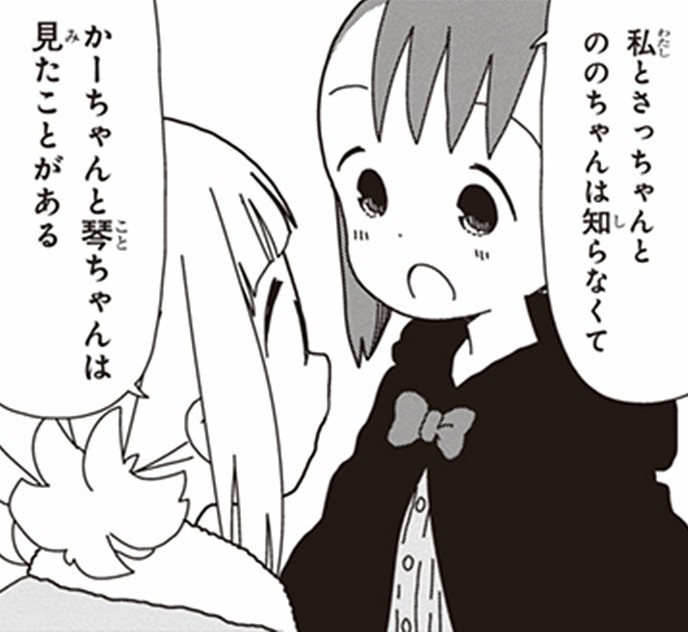
Sacchan and her friends come across a torn piece of paper with 「あたり100」 written on it. Thinking it may be for a 100,000 yen prize, the girls head to the shopping district to redeem it. Along the way, their friend Nonoko says she doesn’t recognize where the ticket is from, but Sacchan’s mother says it looks familiar somehow. Kotoha admits it seemed familiar to her as well, but she thought it was just her imagination until now.
- 結衣:
- 「私とさっちゃんとののちゃんは知らなくて」
- “Even though Sacchan, Nono-chan, and I don't know it...”
- さっちゃん:
- 「かーちゃんと琴ちゃんは見たことがある」
- “My mom and Koto-chan have seen it before.”
- Literal: “Mom and Koto-chan have a thing where they saw it.”
Key Points
- 見たことがある says Sacchan’s mom and Kotoha have seen the ticket or something like it before.
- The pattern does not say they are seeing it now; it points to memory.
- かーちゃん is a childlike way to say mom.
- ちゃん is an affectionate, informal suffix attached to names, used mainly for children, close friends, and family members.
Vocabulary
| Word | English | Meaning |
|---|---|---|
| 私 | I | 私 means “I” or “me”. It is the standard first-person pronoun in polite speech and is also common in casual speech among women. |
| 知る | To know | 知る means to learn or come to know a fact or person. In the form 知っている, it describes already knowing. |
| 見る | To see | 見る is to see, look at, or watch something. It also means to check or judge something, or to look after someone, as in 面倒を見る. |
| こと | Thing | こと is an abstract thing, matter, or fact, as opposed to a physical object. It also turns a verb phrase into a noun, as in 見たことがある. It is also written 事. |
| ある | To exist | ある is to exist or be in a place, for things and plants rather than people or animals. It also means to have something, or for an event to take place. |
See Also
- Grammar: Previous experience with 〜た+ことがある
- Grammar: Past tense with 〜た・〜だ
- Grammar: Marking the topic with は and も
- Grammar: Connecting actions with 〜て・〜で
- Kanji: Privacy and self with 私
- Kanji: Seeing and viewpoints with 見