Having to run in the heat with ただでさえ
Grammar Explanation: Even and as long as with 〜さえ
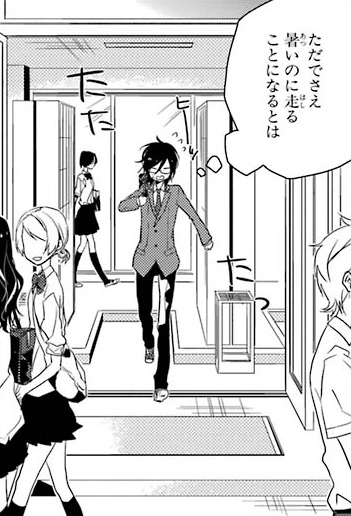
Hori plans to rush to the supermarket after school for its egg time sale, which ends at 4:00, as long as no surprise committee meeting comes up. The next day, one does. Stuck at the meeting, she texts Miyamura, leaving the eggs to him.
- 宮村:
- 「ただでさえ暑いのに走ることになるとは」
- “To think I'd end up running when it's hot enough as it is...”
Key Points
- ただでさえ is a set phrase. ただ means “ordinary” or “plain”, and さえ is “even”. Together they mean “even in the normal state”.
- It sets a baseline that’s already hard before something else gets added. Here the heat alone is bad enough.
- ただでさえ usually pairs with のに or から. 暑いのに is “when it’s hot”, with a note of complaint.
- The full pattern is “X is already the case, and on top of that, Y”.
- 〜ことになる means something ends up being the case because of circumstances or someone else’s decision.
- Miyamura didn’t plan to run. Hori’s text decided it for him.
- A sentence ending in とは means “to think that…”. It is short for something like とは思わなかった, “I never thought”.
- It shows Miyamura’s surprise and exasperation at how his afternoon turned out.
Vocabulary
ただでさえ (As it is)
ただでさえ means “even under normal circumstances”. It describes a situation that is already hard or extreme before something else gets added to it, as in ただでさえ忙しいのに, “when I’m busy enough as it is”.
暑い (Hot)
暑い describes hot weather or air.
走る (To run)
走る is to run.
こと (Thing)
こと is an abstract thing, matter, or fact, as opposed to a physical object. It also turns a verb phrase into a noun, as in 見たことがある. It is also written 事.
なる (To become)
なる is to change into a different state or become something. It also means something turns out a certain way. It is also written 成る.
See Also
- Grammar: Even and as long as with 〜さえ
- Grammar: Even though with 〜のに
- Grammar: To end up being with 〜ことになる