Heard about the effects of the hot water 〜らしい
Grammar Explanation: Conjecture with 〜らしい
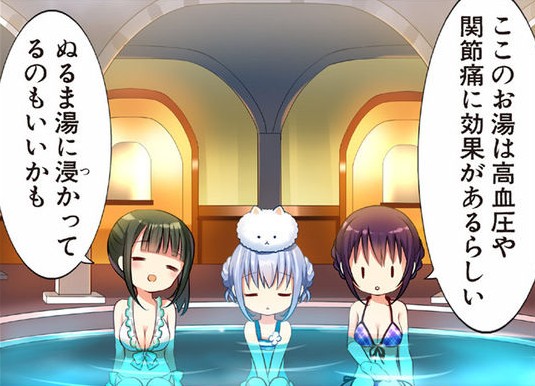
Rize and her friends visit an indoor hot spring.
- リゼ:
- 「ここのお湯は高血圧や関節痛に効果があるらしい」
- “Apparently, the hot water here is effective for high blood pressure and joint pain.”
- Literal: “It seems the hot water here has effects on high blood pressure and joint pain.”
- 千夜:
- 「ぬるま湯に浸かってるのもいいかも」
- “Maybe soaking in lukewarm water isn't so bad.”
Key Points
- The translation “apparently” shows that Rize is relaying a reported property of the hot spring.
- 高血圧や関節痛に names the conditions the water is said to help.
- や links high blood pressure and joint pain without claiming those are the only listed uses.
- Chiya tentatively suggests that soaking in lukewarm water may be pleasant rather than stating it as a fact.
- The い drops in casual speech while the form still describes the state of soaking.
Vocabulary
| Word | English | Meaning |
|---|---|---|
| ここ | Here | ここ is the place where the speaker is. |
| お湯 | Hot water | お湯 is heated water. At a hot spring or bath, it also means the bath water itself. |
| 高血圧 | High blood pressure | 高血圧 is blood pressure that stays above the healthy range. The opposite is 低血圧, low blood pressure. |
| 関節痛 | Joint pain | 関節痛 is an ache in the knees, hips, or other joints, a common complaint with age or a fever. |
| 効果 | Effect | 効果 means the effect or result produced by an action, method, or treatment. |
| ぬるま湯 | Lukewarm water | ぬるま湯 is water that is only slightly warm. It also describes a comfortable situation without challenge. |
| 浸かる | To soak | 浸かる is to be in water up to a certain point, such as soaking in a bath. |
| いい | Good | いい describes something good, nice, or fine. It can also mean “okay” or “that’s enough”. Its other forms come from よい, as in よくない and よかった. |
See Also
- Grammar: Conjecture with 〜らしい
- Grammar: Marking the topic with は and も
- Grammar: Might with 〜かもしれない
- Grammar: Ongoing actions and resulting states with 〜ている
- Grammar: How casual contractions work