Help me if you're bored with 〜てちょうだい
Grammar Explanation: Requests with 〜てください and 〜てくれ
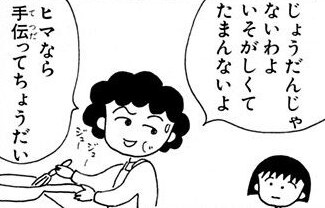
Maruko wakes up early for once, because she fell asleep in the kotatsu the night before. Her mother is busy making breakfast in the kitchen. Maruko wanders in and complains that six in the morning is boring, with nothing good on TV.
- お母さん:
- 「じょうだんじゃないわよ いそがしくてたまんないよ」
- “Don't be ridiculous. I'm swamped.”
- 「ヒマなら手伝ってちょうだい」
- “If you've got nothing to do, give me a hand.”
Key Points
- 手伝って is the て-form of 手伝う, “to help”. ちょうだい after it turns the verb into a request: “help me”.
- 〜てちょうだい is familiar and comes most often from women and from parents speaking to children. 手伝ってください would sound oddly distant toward her own daughter, and 手伝ってくれ would sound blunt and masculine.
- Familiar isn’t the same as gentle. In this line ちょうだい carries an order, not a favor she hopes Maruko will grant.
- ヒマ (暇) means free time or having nothing to do. Maruko has just said the world at six in the morning is ヒマ.
- なら means “if that’s the case”. It takes what the listener said as given and builds on it: if you’re so bored, then help.
- じょうだん (冗談) means a joke. じょうだんじゃない, literally “that’s no joke”, means “don’t be ridiculous” or “no way”.
- わよ adds emphasis in a traditionally feminine style. The mother is contradicting Maruko’s idea that the morning is idle.
- 〜てたまらない after an adjective means “so … I can’t stand it”. いそがしくて is the て-form of いそがしい, “busy”.
- たまんない is a casual contraction of たまらない, with ら becoming ん before な.
Vocabulary
じょうだん (Joke)
じょうだん is the kana spelling of 冗談, something said to make people laugh rather than meant seriously. じょうだんじゃない means “don’t be ridiculous” or “no way”.
ない (Not)
ない means something does not exist or someone does not have it. After a verb, it makes the verb negative. It is also written 無い.
いそがしい (Busy)
いそがしい is the kana spelling of 忙しい. It describes having a lot to do and no time to spare.
たまらない (Unbearable; irresistible)
たまらない means something is too much to bear. After a て-form, as in いそがしくてたまらない, it means “so busy I can’t stand it”. It can also praise something as irresistible. In casual speech it often becomes たまんない.
ヒマ (Free time)
ヒマ is free time with nothing to do. It is also written 暇.
手伝う (To help)
手伝う means to help someone with their work or chores by doing part of it.
ちょうだい (Give me; please)
ちょうだい is the kana spelling of 頂戴. After a noun it means “give me”, and after a て-form verb it makes a familiar request, as in 呼んでちょうだい, “call me”. It sounds close and friendly, and women, children, and older people speaking to younger ones use it most.
See Also
- Grammar: Requests with 〜てください and 〜てくれ
- Grammar: If that's the case with なら
- Grammar: Informing with よ
- Grammar: How casual contractions work
- Kanji: Hands and skill with 手