Honorific or humble language with 謙譲語
Kanji Explanation: Humility and modesty with 謙
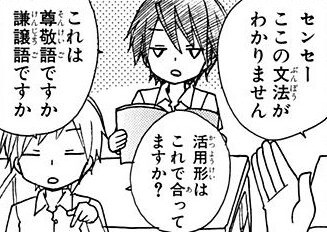
Students ask their teacher, Mittan, how long she has gone without a boyfriend. Mittan declares it top secret and tells them the only thing they may ask their teacher about is their studies.
- 生徒:
- 「センセー ここの文法がわかりません」
- “Miss, I don't understand the grammar here.”
- 淳平:
- 「活用形はこれで合ってますか?」
- “Is this the right conjugation?”
- 結心:
- 「これは尊敬語ですか謙譲語ですか」
- “Is this honorific language or humble language?”
Key Points
- 謙譲語 is the part of 尊敬語, respectful speech, where you show respect by lowering yourself or your side. For example, 行く becomes 伺う and 言う becomes 申す when you talk about your own actions.
- The 謙 in 謙譲語 is the same humility found in 謙虚 and 謙遜. Here it names a grammatical category, not a personality trait.
- 尊敬語 raises the actions of the person you respect: 行く becomes いらっしゃる and 言う becomes おっしゃる.
- The two are easy to confuse because both show respect. One lifts the other person; the other lowers yourself.
- Placing two questions side by side, each ending in ですか, asks the listener to choose between them. これは尊敬語ですか謙譲語ですか means “Is this honorific or humble language?”
Vocabulary
| Word | English | Meaning |
|---|---|---|
| センセー | Teacher | センセー is a katakana spelling of 先生, a teacher, often used when calling out to one in a drawn-out, casual way. |
| ここ | Here | ここ is the place where the speaker is. |
| 文法 | Grammar | 文法 is grammar, the rules for how words combine into sentences in a language. |
| わかる | To understand | わかる is to understand something, or for something to become known or clear. It is also written 分かる. |
| 活用形 | Conjugated form | 活用形 is one of the forms a Japanese verb, adjective, or auxiliary takes when it conjugates, such as the negative or conditional stem. |
| 合う | To fit | 合う is to fit or match something, or to suit someone. It also means for things to agree, like answers or tastes. |
| これ | This | これ points to something close to the speaker, or to the thing just mentioned. |
| 尊敬語 | Honorific language | 尊敬語 is honorific language, the kind of respectful speech that raises the actions of the person you are talking to or about, as in いらっしゃる for 行く. |
See Also
- Kanji: Humility and modesty with 謙
- Grammar: Polite style with です and ます
- Kanji: Joining and fitting with 合
- Kanji: Living and lively movement with 活
- Kanji: Patterns and writing with 文