Hopeless when it comes to herself with 〜のこととなると
Grammar Explanation: Referring to a person with 〜のこと
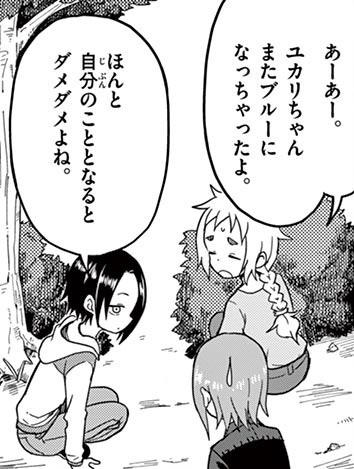
Yukari is out with her friends Mina and Sanae when they spot the Nishikata family and follow them at a distance. Watching Chii ride on her father’s back as she races her mother home, Yukari sighs that she wants a marriage like that someday.
- ミナ:
- 「あーあー。ユカリちゃんまたブルーになっちゃったよ。」
- “Uh-oh. Yukari's feeling blue again.”
- サナエ:
- 「ほんと自分のこととなるとダメダメよね。」
- “She really falls apart when it comes to herself.”
Key Points
- 〜のこととなると means “when it comes to”. The rest of the sentence says how the person acts there, which is different from how they usually act.
- 自分 refers back to Yukari: her own love life, as opposed to the couples she likes to watch.
- Doubling ダメ makes it stronger: “totally hopeless”. よね asks Mina to agree.
- ブルー comes from English “blue” and means “down” or “depressed”. 〜になっちゃった is a casual 〜になってしまった.
- あーあー is a sigh, “oh dear” or “uh-oh”.
Vocabulary
また (Again)
また means “again” or “once more”. It also means “also”. As a goodbye, またね means “see you”.
ブルー (Blue)
ブルー is the color blue. In casual speech, it also means feeling down, as in ブルーになる, “get depressed”.
なる (To become)
なる is to change into a different state or become something. It also means something turns out a certain way. It is also written 成る.
ほんと (Really)
ほんと is a casual form of 本当, “truth”. It is used as an adverb meaning “really” or “truly”, or on its own as “Really?”
自分 (Oneself)
自分 is oneself. It refers back to the person doing the action, and some speakers use it to mean “I”.
こと (Thing)
こと is an abstract thing, matter, or fact, as opposed to a physical object. It also turns a verb phrase into a noun, as in 見たことがある. It is also written 事.
ダメダメ (Hopeless)
ダメダメ doubles ダメ to say that someone or something is completely hopeless or no good.