How the body was found with というわけなんです
Grammar Explanation: Logical conclusion with 〜わけだ
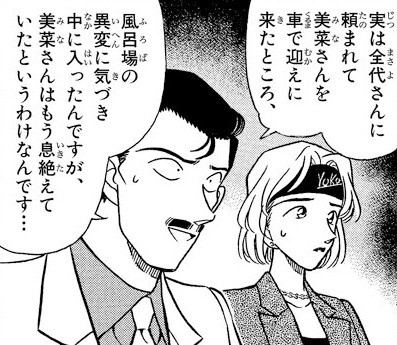
Kogoro lost his ticket to Yoko Okino’s concert. A woman named Masayo gave him a spare on one condition, that he drive her to pick up her sister Mina, who hadn’t shown up. At the house they found the bathroom taped shut from the inside, forced the door, and found Mina dead with a cut wrist. Now Inspector Megure has arrived, and Kogoro tells him why he was there.
- 小五郎:
- 「実は全代さんに頼まれて美菜さんを車で迎えに来たところ、」
- “You see, Masayo asked me to come pick up Mina in my car, and when we got here...”
- 「風呂場の異変に気づき中に入ったんですが、美菜さんはもう息絶えていたというわけなんです…」
- “...we noticed something wrong with the bathroom and went in, but Mina-san was already dead. That's how it happened...”
Key Points
- わけだ presents a statement as making sense given the facts. With という before it, it sums up a whole account: everything Kogoro just said adds up to this situation.
- なんです is polite explanatory のです. It presents the account as background the inspector needs, in a respectful register.
- Without it, the line would just report that Mina was dead. With it, Kogoro tells Megure, “and that’s the whole story of how we found her.”
- Past tense + ところ means “when I did X” and introduces what was found or what happened next. It often leads into something unexpected.
- Here, coming to pick up Mina leads into the discovery in the next balloon.
- 気づき is the stem of 気づく, “to notice”. In formal speech and writing, the stem can join clauses like the て-form: 気づき中に入った means 気づいて中に入った.
- Kogoro uses it because he is giving a formal statement to the police.
- 息絶える means “to breathe one’s last”. It’s a formal, softer way to say someone died.
- 〜ていた describes the state they found: by the time they went in, she was already dead. もう stresses “already”.
Vocabulary
実は (Actually)
実は introduces the truth, often something the listener did not know: “to tell the truth”.
頼む (To ask)
頼む is to ask someone to do something, or to order something.
車 (Vehicle or wheel)
車 means a wheeled vehicle, especially a car. It can also mean a wheel or rotating mechanism.
迎える (To meet)
迎える is to go and meet someone who is arriving. 迎えに来る means to come pick someone up.
来る (To come)
来る means to come or move toward the speaker or the place being discussed.
ところ (Place)
ところ is a place or spot. It also refers to a point in time or a certain aspect of something. It is also written 所.
気づく (To notice)
気づく means to notice something or become aware of it. It can also mean to come to after losing consciousness. It is also written 気付く.
中 (Inside)
中 is the inside of something, or the middle of a situation.
入る (To enter)
入る is to go into a place, or for something to be inside. It also means to join a club or school.
もう (Already)
もう means something has already happened, or with a negative, “no longer”. Before a number, it means “more”. Said alone, it shows frustration.
息絶える (To die)
息絶える means to breathe one’s last, to die. It is a formal or literary way to describe the moment of death.
わけ (Reason)
わけ is a reason or meaning. It also appears in grammar patterns such as わけがない, “there’s no way”, and わけにはいかない, “can’t very well”.
See Also
- Grammar: Logical conclusion with 〜わけだ
- Grammar: Reasoning with 〜のだ
- Grammar: Coming to for a purpose with 〜に来る
- Grammar: Receptive verbs with 〜れる
- Grammar: Contrasting with 〜が〜
- Kanji: Difference and strangeness with 異
- Kanji: Entering and putting in with 入
- Kanji: Vehicles and wheels with 車