Human magic won't stand a chance with 〜まい
Grammar Explanation: Negative conjecture with 〜まい
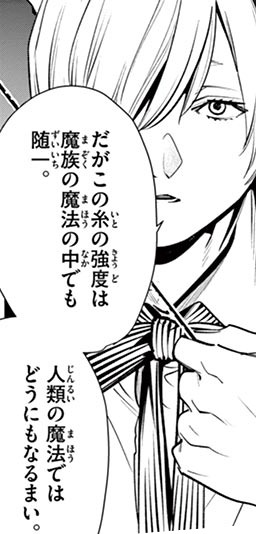
The demon Draht has slipped into the town jail where Frieren is held, intending to kill her. He wrapped invisible threads of mana around her neck and pulled to behead her, but she blocked the cut by concentrating her mana in her neck. Draht admits she kept her cool and warns that an ordinary mage would have lost their head before realizing what was happening.
- ドラート:
- 「だがこの糸の強度は魔族の魔法の中でも随一。」
- “But this thread is stronger than anything else in demon magic.”
- 「人類の魔法ではどうにもなるまい。」
- “Human magic won't be able to do a thing against it.”
Key Points
- どうにもならない means “nothing can be done” or “it’s hopeless”. Replacing ならない with なるまい turns it into a guess: “surely nothing can be done”.
- まい is an old-fashioned negative that works like ないだろう here. Its subject is human magic, not Draht’s own action, so it’s a guess and not a vow.
- The literary まい suits Draht, a demon who speaks in a stiff, menacing way.
- で marks the means: 人類の魔法で is “with human magic”.
- は sets it apart from demon magic. Human magic, unlike demon magic, won’t be enough.
- Demons in this story see humans as a separate, weaker race. 人類, “humankind”, draws that line between Frieren’s side and his.
- 〜の中でも means “even among”. It singles out one thing from a group.
- 随一 means “the best” or “second to none”. Draht says his thread’s strength ranks first even among demon magic.
- The line drops the copula at the end. 随一。 stands for 随一だ, a terse style that fits his boast.
- Sentence-initial だが means “but” or “however”. Draht has just conceded that Frieren survived his first attack, and だが turns to why she still can’t win.
- だが is stiffer than でも or だけど. It suits a formal, dramatic speaker.
Vocabulary
この (This)
この means “this” or “these” and comes directly before a noun. It points to something near the speaker or something the speaker is referring to in the conversation.
強度 (Strength)
強度 is how strong something is, such as how well a material holds up against force, or the intensity of a feeling or effect.
魔族 (Demons)
魔族 is a race or clan of demons, usually in fantasy stories.
魔法 (Magic)
魔法 means magic, sorcery, or a magical spell.
中でも (Above all)
中でも means “especially” or “above all”, singling out one thing from a group. After a noun with の, it means “even among”.
人類 (Humanity)
人類 refers to the collective group of all humans on Earth, or, biologically speaking, the genus Homo (Homo sapiens) within the order Primates. It represents the entire human species as a single entity, transcending differences in nationality, race, culture, and other factors.
どうにも (In no way)
どうにも means “in no way” or “no matter what” with a negative, as in どうにもならない “nothing can be done”. With a positive, it means “really” or “terribly”.
なる (To become)
なる is to change into a different state or become something. It also means something turns out a certain way. It is also written 成る.
まい (Probably not)
まい is an old-fashioned negative ending. It guesses that something probably won’t happen, like ないだろう, or states a decision not to do something, like ないつもりだ.
See Also
- Grammar: Negative conjecture with 〜まい
- Grammar: Contrasting with 〜が〜
- Grammar: Marking the topic with は and も
- Kanji: Measures and degrees with 度
- Kanji: People and persons with 人
- Kanji: Strength and force with 強