I wish I could go into a hole with 穴があったら入りたい
Idiom Explanation: Feeling greatly embarrassed with 穴があったら入りたい
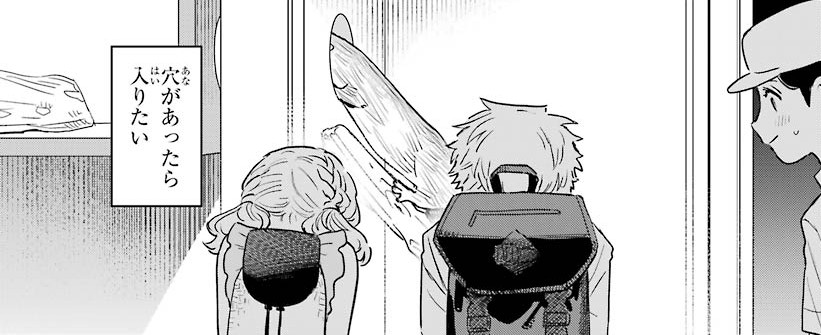
To avoid being spotted by classmates while on a date at the aquarium, Mie switches to calling Komura by his given name. Komura tries to do the same, but is unable to. They stop by to see an otter. Hearing the otter’s name is Ai-chan, Komura realizes he can practice saying Mie’s given name, Ai, without embarrassment if he’s addressing an otter. After Komura greatly compliments Ai-chan, the otter, on how cute she is, he realizes he’s embarrassed Mie, embarrassing himself at the realization.
- 小村:
- 「穴があったら入りたい」
- “I wish there was a hole I could go into...”
- Literal: “If there were a hole, I would want to go in.”
There’s a visual play here, as the otter is going into a hole, something Komura himself is unable to do.
Key Points
- Literally, the phrase means “if there were a hole, I would want to enter it”.
- Idiomatically, Komura wishes he could disappear because he is so embarrassed.
- あったら is the conditional form of ある, meaning if there were.
- The sentence imagines a convenient hole that does not actually exist for Komura.
- The otter can go into a hole, while Komura can only wish for one.
- That contrast makes the stock expression fit the aquarium scene especially closely.
Vocabulary
| Word | English | Meaning |
|---|---|---|
| 穴 | Hole | 穴 is a hole or opening in something. It also means a gap or weak point. |
| ある | To exist | ある is to exist or be in a place, for things and plants rather than people or animals. It also means to have something, or for an event to take place. |
| 入る | To enter | 入る is to go into a place, or for something to be inside. It also means to join a club or school. |