I'd totally die in the heat with 〜じゃう
Grammar Explanation: Doing completely or ending up doing with 〜てしまう and 〜ちゃう
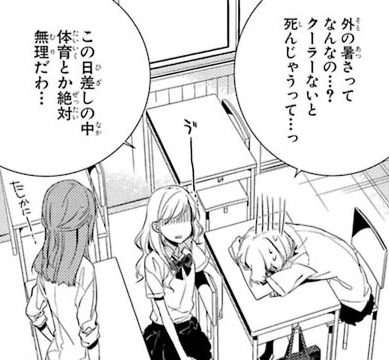
On a summer day, Hori and her friends in class can’t ignore the heat.
- 由紀:
- 「外の暑さってなんなの…? クーラーないと死んじゃうって…っ」
- “What's with this heat outside...? I'd totally die without the AC...”
- Literal: “What is this outside heat...? Without an air conditioner, I would end up dying...”
- 「この日差しのなか体育とか絶対無理だわ…」
- “There's no way I can do PE in this blazing sun...”
Key Points
1死んじゃう = “I’ll end up dying”
- 死んじゃう is the casual spoken contraction of 死んでしまう, from 死ぬ + 〜でしまう
2Why じゃう follows ん
- For verbs whose て-form ends in で, 〜でしまう contracts to 〜じゃう in casual speech.
- 死ぬ becomes 死んで, then 死んでしまう becomes 死んじゃう.
3クーラーないと sets the condition
- クーラー(が)ないと means “if there is no AC” or “without the AC”; the subject marker が is omitted in casual speech.
Vocabulary
この (This)
この means “this” or “these” and comes directly before a noun. It points to something near the speaker or something the speaker is referring to in the conversation.
体育 (Physical education)
体育 means physical education, exercise taught to develop fitness and physical skills.
絶対 (Absolute)
絶対 means absolute or unconditional. As an adverb, it means definitely or under no circumstances, depending on the sentence.
無理 (Impossible)
無理 means impossible, unreasonable, or too demanding. In conversation, it can mean “that’s impossible” or warn someone not to push too hard.
See Also
- Grammar: Doing completely or ending up doing with 〜てしまう and 〜ちゃう
- Grammar: Natural result with 〜と
- Kanji: Absence and nothingness with 無
- Kanji: Body and substance with 体
ホリミヤ © its respective creators. It is used here for educational commentary.