If anything happens, Conan will protect me with いざとなったら
Grammar Explanation: When the time comes with いざ〜となると
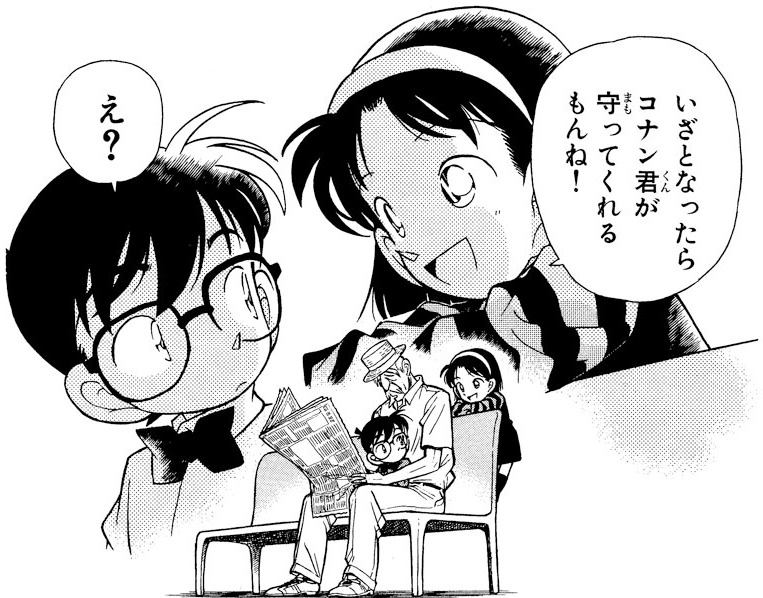
During a game of hide-and-seek in the park, Conan hides on a bench behind an old man’s newspaper. The paper reports a fourth victim of a kidnapper who kills pretty girls. Ayumi is hiding on the same bench. She jokes that a girl like her must be in real danger, but says she isn’t worried.
- 歩美:
- 「いざとなったらコナン君が守ってくれるもんね!」
- “If anything happens, you'll protect me, right?”
- コナン:
- 「え?」
- “Huh?”
Key Points
- いざとなったら sets up an emergency the speaker can picture but hopes won’t happen. Here, it’s the kidnapper coming after Ayumi.
- What follows is the backup plan. If the worst happens, Conan will step in.
- いざとなれば means the same thing. The たら and ば conditionals both make it an “if”.
- 守る means “protect”. くれる after the て-form makes the protection a favor done for the speaker.
- が marks Conan as the one who acts. Nobody says who gets protected, because くれる already points at Ayumi.
- Ayumi uses Conan’s name while talking to him. Japanese often uses a name where English would say “you”.
- もん gives a reason in a casual, childlike way. Here it’s her reason for not worrying.
- ね asks Conan to agree, which puts him on the spot. That’s why he says え?
Vocabulary
いざ (Actually, for real)
いざ marks the moment something stops being a plan and has to be done for real, as in いざ買うとなると, “when it actually comes to buying”. On its own, it’s an old-fashioned “Now then!” said before starting something.
なる (To become)
なる is to change into a different state or become something. It also means something turns out a certain way. It is also written 成る.
君 (You)
君 is a word for “you” used toward equals or people younger or of lower standing. It sounds gentle or poetic. Read くん, it is a suffix on names.
守る (To protect)
守る is to protect someone from danger. It also means to keep a promise or obey a rule.
くれる (To give)
くれる is for someone to give something to the speaker or the speaker’s side. After a て-form verb, it means someone does something for the speaker.
もん (Because)
もん ends a sentence to give a reason, often in a childish or pouting tone. It is a casual form of もの.
See Also
- Grammar: When the time comes with いざ〜となると
- Grammar: Receiving kindness with 〜てくれる
- Grammar: If and when with 〜たら
- Grammar: Casual reasons with 〜もん