If only it weren't portable shogi with 〜さえ
Grammar Explanation: Even and as long as with 〜さえ
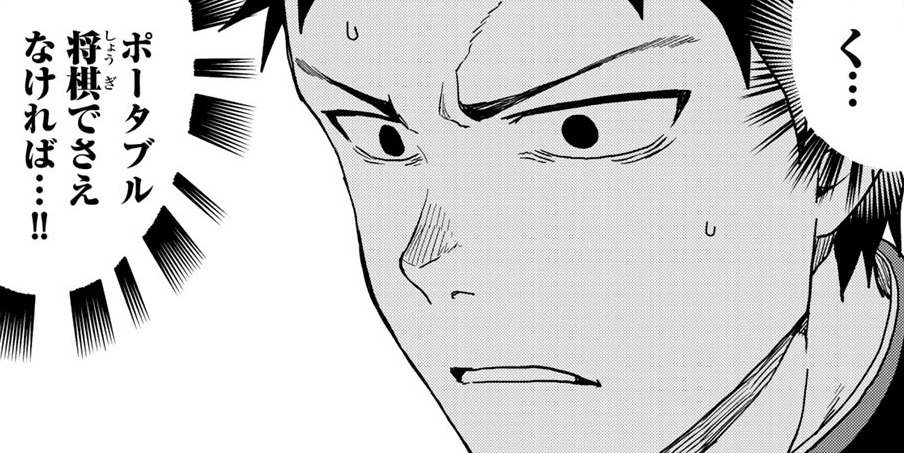
Takeru, the shogi club’s new member, is playing Urushi on the club’s board, so Ayumu is left with a portable shogi set. Urushi praises the crisp sound Takeru makes when he snaps a piece down. Ayumu tells her he can make a much better sound than Takeru and slaps down a piece of his own, but it only makes a feeble “peko”.
- 歩:
- 「く…」
- “Ngh...”
- 「ポータブル将棋でさえなければ…!!」
- “If only this weren't portable shogi...!!”
Key Points
1If only with でさえなければ
- さえ with a negative condition means “if only ~ weren’t”. It names the one obstacle. Without it, everything would be fine.
- Start from ポータブル将棋でない, “it isn’t portable shogi”. Its conditional is でなければ, “if it isn’t portable shogi”. Put さえ after で, and you get でさえなければ, “if only it weren’t portable shogi”.
- Ayumu doesn’t say what would happen then. His boast a moment ago fills in the rest. Without the portable set, he’d have made a better sound than Takeru.
2Portable shogi with ポータブル将棋
- ポータブル comes from English “portable”. A ポータブル将棋 set is a small folding board with light pieces, often magnetic, made for travel.
- A thick wooden board and wooden pieces give a sharp click when a piece is snapped down. That’s the いい音 Urushi praised in Takeru’s play. A light portable piece can only manage the flat ペコ that came out when Ayumu tried.
3A frustrated grunt with く…
- く… is the sound of gritted teeth, like “ngh” or “argh”. Manga characters use it, often as くっ or くそ, when they’ve lost or been shown up.
Vocabulary
ポータブル (Portable)
ポータブル describes something made small and light enough to carry around, such as a portable radio or a travel game set. It comes from English “portable”.
将棋 (Shogi)
将棋 means Japanese chess, the board game of ranked pieces and tactical play.
ない (Not)
ない means something does not exist or someone does not have it. After a verb, it makes the verb negative. It is also written 無い.
See Also
- Grammar: Even and as long as with 〜さえ
- Grammar: Hypothetical condition with 〜ば
それでも歩は寄せてくる © its respective creators. It is used here for educational commentary.