Indiscriminate murder would be one thing if with 〜ならともかく
Grammar Explanation: It might be one thing if with 〜ならともかく
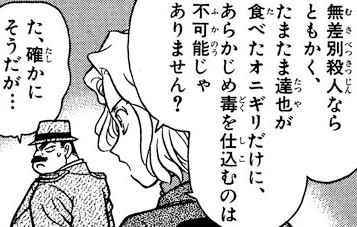
Sonoko is invited to a band’s after party. During the get-together, the band’s singer Tatsuya eats a rice ball only to collapse and die. The police are called in, and Inspector Megure discovers the victim was poisoned. He accuses the man who prepared the food, but Conan bites into a rice ball to show it’s safe. The victim’s manager, Mari, agrees.
- 麻理:
- 「無差別殺人ならともかく、たまたま達也が食べたオニギリだけに、あらかじめ毒を仕込むのは不可能じゃありません?」
- “If it were indiscriminate murder, that's one thing but since it was just the rice ball Tatsuya happened to eat, wouldn't it be impossible to poison it beforehand?”
- Literal: “If it were indiscriminate murder, that would be one thing, but isn't it impossible to plant poison beforehand only in the rice ball Tatsuya happened to eat?”
- 目暮:
- 「た、確かにそうだが…」
- “Th-that's true.”
Key Points
1Polite register with ません
- Megure is an authority figure, so Mari uses a polite way of speaking toward him.
2〜ならともかく = that would be one thing, but
- Mari presents one scenario as imaginable and contrasts it with the actual case.
- Here it means “if it were indiscriminate murder, that would be one thing…”
3だけに narrows it to that one rice ball
- オニギリだけに means “in just that one rice ball”.
- That makes the method sound implausibly precise for a pre-planted poisoning.
Vocabulary
食べる (To eat)
食べる means to eat or consume food.
毒 (Poison)
毒 means poison. It also describes anything harmful, including a corrupting influence or malicious words.
不可能 (Impossible)
不可能 means impossible or unable to be done.
See Also
- Grammar: It might be one thing if with 〜ならともかく
- Future entry: Past tense with 〜た・〜だ
- Grammar: Polite style with です and ます
- Grammar: Marking the topic with は and も
- Grammar: If that's the case with なら
- Kanji: Ability and capability with 能
- Kanji: Negation and lack with 不
- Kanji: Poison and toxicity with 毒
名探偵コナン © its respective creators. It is used here for educational commentary.