Interpretating dancing flower petals with 解釈
Kanji Explanation: Separating and understanding with 解
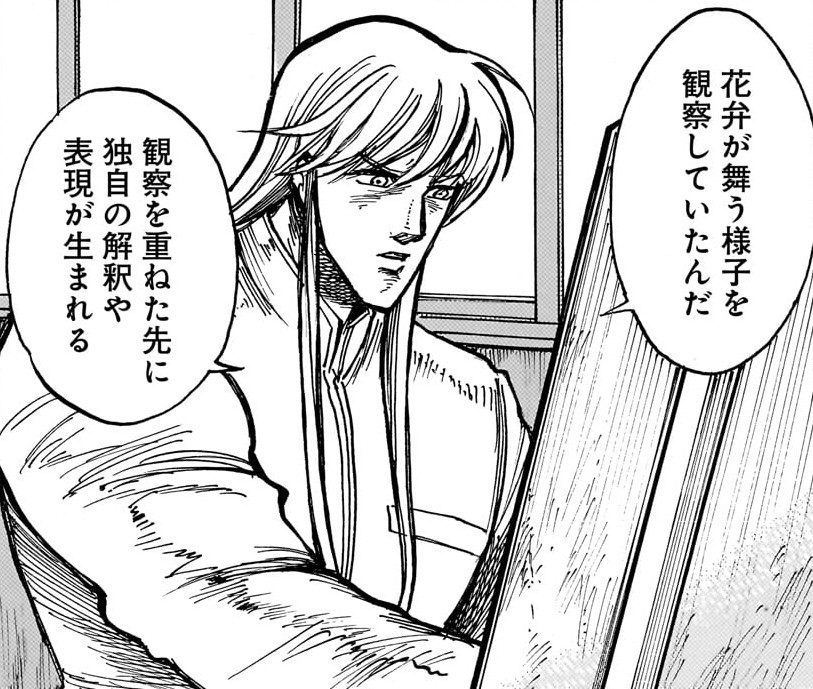
As she models for a sketch, Lulu recalls seeing Hideki blowing flower petals into the air. She brings it up to him.
- 秀樹:
- 「花弁が舞う様子を賢察していたんだ」
- “I was observing the petals as they danced.”
- Literal: “I was observing the state of the flower petals dancing.”
- 「観察を重ねた先に独自の解釈や表現が生まれる」
- “Through repeated observation, unique interpretations and expressions emerge.”
- Literal: “Beyond repeated observation, one's own interpretations and expressions are born.”
Key Points
1解釈 = “interpretation” in an artistic sense
- Here, 解釈 means the personal meaning or reading Hideki draws from what he has observed, not just a literal “explanation”.
- In this scene, it is paired with 表現 (expression), so the idea is that his way of understanding the petals leads into how he then expresses that understanding in art.
2観察を重ねた先に = “after repeated observation”
- This phrase sets up a progression: first he keeps observing, and then something new emerges from that process.
- 先に here is not just physical “ahead”; it means “beyond that stage” or “further on from there”.
3独自の adds the idea of originality
- 独自の means “one’s own” or “unique”, so 独自の解釈 is not just any interpretation, but a personally developed one.
- That matches the scene’s creative context: careful observation leads to a distinct artistic viewpoint.
Vocabulary
花弁 (Petal)
花弁 means a flower petal.
様子 (State)
様子 is how someone or something looks, seems, or is doing. It can describe a person’s condition, the mood of a place, or the state of a situation.
観察 (Observation)
観察 means watching or examining something carefully to understand it.
表現 (Expression)
表現 means expression or representation. It is the act or form of conveying an idea or feeling through words, art, movement, or another medium.
See Also
- Kanji: Separating and understanding with 解
- Future entry: Past tense with 〜た・〜だ
- Grammar: The copula だ
- Kanji: Childhood and small things with 子
- Kanji: Forms and appearances with 様
キラキラとギラギラ © its respective creators. It is used here for educational commentary.