Is your dad still a detective with 〜の
Grammar Explanation: Reasoning with 〜のだ
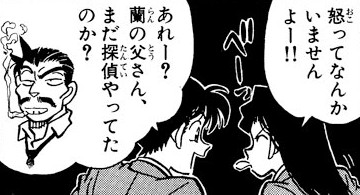
Ran seems angry as Shin’ichi basks in the media attention he’s getting for solving a difficult case. When Shin’ichi asks Ran why she’s angry, she points out that it’s because of Shin’ichi that her father’s been getting fewer case requests.
- 蘭:
- 「怒ってなんかいませんよー!!」
- “I'm not at all angry!”
- 新一:
- 「あれー?蘭の父さん、まだ探偵やってたのか?」
- “Huh? Your dad was still working as a detective?”
- Literal: “Huh? Is it that your dad was still working as a detective?”
Key Points
1Incomplete Observation
- Shin’ichi has the incomplete observation that Ran’s father is losing work taking cases because of Shin’ichi’s detective work. Considering how bad Ran’s father is at being a detective, it’s surprising to Shin’ichi that he’s still in the detective business. However, based on Ran’s remark, Shin’ichi reasons that her father must still be working as a detective. He puts this as a question for confirmation.
2Shin’ichi drops the object particle を
- 探偵やってた is casual for 探偵をやっていた.”
- With a job or role, Ⓐをやる means “to work as Ⓐ” or “to be Ⓐ”. Speakers often omit を in casual conversation.
Vocabulary
探偵 (Detective)
探偵 means a detective or private investigator who gathers information about people or incidents.
See Also
- Grammar: Reasoning with 〜のだ
- Future entry: Past tense with 〜た・〜だ
- Grammar: Ongoing actions and resulting states with 〜ている
- Kanji: Searching and probing with 探
名探偵コナン © its respective creators. It is used here for educational commentary.