It's not like you're a foreigner with 〜じゃあるまいし
Grammar Explanation: It's not the case with 〜ではあるまいし
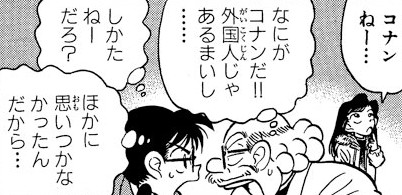
Shin’ichi’s teenage friend Ran enters Professor Agasa’s house looking for him, unaware that he was forced to take a poison that inadvertently turned the teenager into a young child. When Ran sees the boy and asks his name, Shin’ichi recalls Agasa’s suggestion to not reveal who he is. Panicking, he gives the name “Conan”, explaining the oddness of it by saying his father is a fan of author Arthur Conan Doyle.
- 欄:
- 「コナンねー…」
- “Conan, huh?”
- 阿笠:
- 「なにがコナンだ!! 外国人じゃあるまいし」
- “What's with 'Conan'!? It's not like you're a foreigner...”
- Literal: “What do you mean, Conan!! It's not as if you're a foreigner.”
- コナン:
- 「しかたねーだろ? ほかに思いつかなかったんだから…」
- “It couldn't be helped, all right? I couldn't think up anything else...”
Key Points
1外国人じゃあるまいし = it’s not like you’re a foreigner
- Agasa is criticizing the obviously foreign-sounding name Conan.
- The phrase implies “you’re Japanese, so why would you use a name like that?”
2じゃあるまいし rejects a premise as inapplicable
- Agasa brings up one category, being a foreigner, and dismisses it as not the case here.
- That makes the chosen name sound unreasonable or absurd.
3なにがコナンだ conveys exasperation
- This opening is not a literal information question.
- It is a scolding “what’s this ‘Conan’ supposed to be?”
Vocabulary
外国人 (Foreigner)
外国人 means a foreign national or citizen of another country.
See Also
- Grammar: It's not the case with 〜ではあるまいし
- Future entry: Past tense with 〜た・〜だ
- Kanji: Countries and realms with 国
- Kanji: People and persons with 人
名探偵コナン © its respective creators. It is used here for educational commentary.