Just call me Chihiro with 〜のことは〜でいい
Grammar Explanation: Referring to a person with 〜のこと
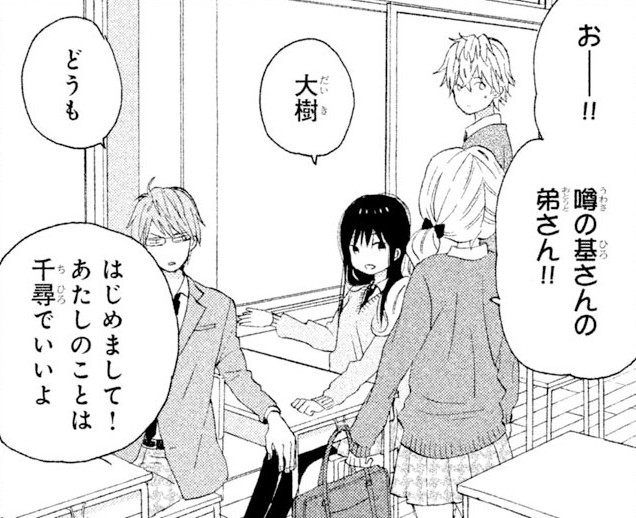
Hiro’s younger brother Daiki has transferred into Mao’s class. Mao introduces him to her friend Oda, and Daiki is put out that her friend is a good-looking guy. Then Mao’s best friend, Chi, drops by the classroom to visit.
- 千尋:
- 「おーー!! 噂の基さんの弟さん!!」
- “Ohhh!! So this is Hiro's little brother I've heard so much about!!”
- 真魚:
- 「大樹」
- “This is Daiki.”
- 大樹:
- 「どうも」
- “Hey.”
- 千尋:
- 「はじめまして! あたしのことは千尋でいいよ」
- “Nice to meet you! You can just call me Chihiro.”
Key Points
- XのことはYでいい is a common way to tell someone what to call you: “Y is fine for me.” The verb 呼ぶ is left out.
- は makes “me” the topic, in place of を.
- 噂の means “the one I’ve heard about”. Mao has told Chihiro about Hiro and his family.
- Chihiro adds さん to 弟, a polite way to refer to someone else’s little brother.
- どうも on its own is a brief, low-key greeting. It fits Daiki’s sulky mood.
Vocabulary
噂 (Rumor)
噂 is talk about someone that gets passed around, often unconfirmed. 噂の〜 means “the ~ people talk about” or “the ~ I’ve heard about”.
弟 (Younger brother)
弟 is a younger brother. To refer politely to someone else’s younger brother, add さん: 弟さん.
はじめまして (Nice to meet you)
はじめまして is the standard greeting when meeting someone for the first time. It is also written 初めまして.
あたし (I)
あたし means “I” or “me”. It is a casual, feminine form of 私.
こと (Thing)
こと is an abstract thing, matter, or fact, as opposed to a physical object. It also turns a verb phrase into a noun, as in 見たことがある. It is also written 事.
いい (Good)
いい describes something good, nice, or fine. It can also mean “okay” or “that’s enough”. Its other forms come from よい, as in よくない and よかった.
See Also
- Grammar: Referring to a person with 〜のこと