Just call me Grandma with 〜てちょうだい
Grammar Explanation: Requests with 〜てください and 〜てくれ
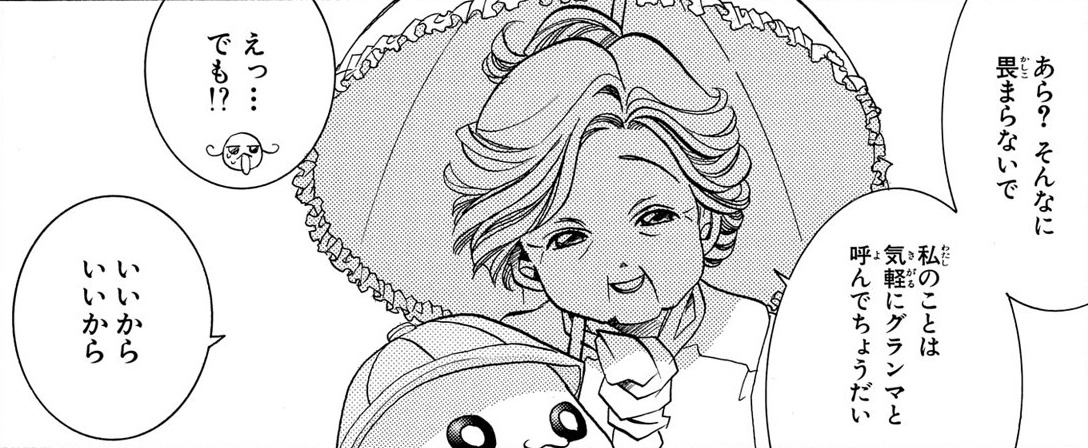
Akari, Aika, and Alice have come to the countryside to train under Grandma, the legendary undine who founded Aria Company. When she greets them by name, Akari blurts out, “Are you… Grandma?” Aika scolds her, then introduces herself with stiff formality, calling the woman “the illustrious Grandmother”, and saying it is an honor to meet her.
- グランマ:
- 「あら? そんなに畏まらないで」
- “Oh? There's no need to be so formal.”
- 「私のことは気軽にグランマと呼んでちょうだい」
- “Feel free to just call me Grandma.”
- 藍華:
- 「えっ… でも!?」
- “Huh? But...!?”
- グランマ:
- 「いいから いいから」
- “Never mind that, it's fine.”
Key Points
- 呼んで is the て-form of 呼ぶ, “to call”. ちょうだい after it asks the listener to do it, so 呼んでちょうだい means “call me”.
- 〜てちょうだい sounds close and familiar, and women and older people in charge use it more. It suits Grandma, who is speaking to young apprentices. 呼んでください would keep more distance, which is the opposite of what she wants.
- 畏まる means to act stiff and respectful toward someone of high standing. Aika had just used her most formal Japanese, with 申します and お目にかかる.
- ないで with no request word after it is a casual “don’t”. そんなに means “that much”, so the whole line is “don’t be so formal”.
- XのことをYと呼ぶ means “call X Y”. と marks the name, グランマ.
- は replaces を here, making 私のこと the topic: “as for me, call me Grandma.” 気軽に means “casually” or “without hesitation”.
- Aika starts to object with でも. いいから means “it’s fine, so…” and cuts her off without giving a reason.
- Saying it twice makes it a gentle but firm “never mind that”. Grandma won’t hear any more about it.
Vocabulary
そんなに (That much)
そんなに describes a degree like the one just mentioned. With a negative, it means “not that much”.
畏まる (To act formal and respectful)
畏まる means to behave stiffly and respectfully in front of someone of high standing, such as sitting up straight or speaking very politely. 畏まらないで tells someone to relax and drop the formality.
私 (I)
私 means “I” or “me”. It is the standard first-person pronoun in polite speech and is also common in casual speech among women.
こと (Thing)
こと is an abstract thing, matter, or fact, as opposed to a physical object. It also turns a verb phrase into a noun, as in 見たことがある. It is also written 事.
呼ぶ (To call)
呼ぶ is to call out to someone, call someone over, or call something by a name.
ちょうだい (Give me; please)
ちょうだい is the kana spelling of 頂戴. After a noun it means “give me”, and after a て-form verb it makes a familiar request, as in 呼んでちょうだい, “call me”. It sounds close and friendly, and women, children, and older people speaking to younger ones use it most.
いい (Good)
いい describes something good, nice, or fine. It can also mean “okay” or “that’s enough”. Its other forms come from よい, as in よくない and よかった.
See Also
- Grammar: Requests with 〜てください and 〜てくれ
- Grammar: Without doing and please don't with 〜ないで
- Grammar: Quoting and reporting with と and って
- Grammar: Marking the topic with は and も
- Kanji: Privacy and self with 私