Just calling her a friend with 〜ことにする
Grammar Explanation: Deciding to with 〜ことにする
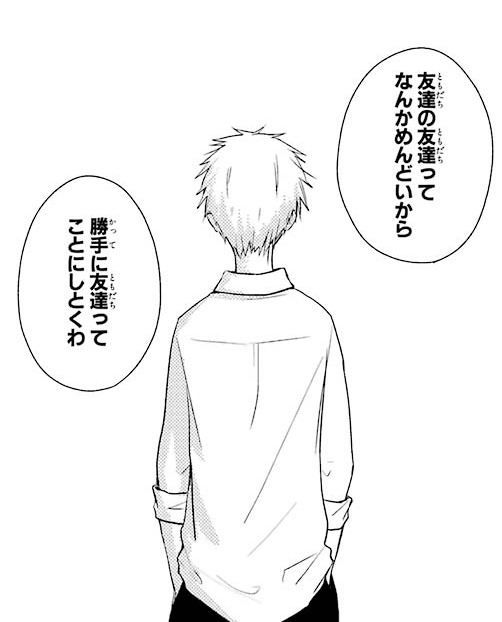
Some classmates mocked Fujimiya for laughing to herself over her exchange diary with Hase. Kiryu, who has taken the diary, told them it was something a friend had left behind, then corrected himself to “a friend’s friend”. He told the girls off and handed the diary back to Fujimiya, who was crying. Now he’s telling her it’s fine to cry, as long as she picks her spot.
- 桐生:
- 「友達の友達ってなんかめんどいから」
- “'Friend of a friend' is kind of a pain to say, so...”
- 「勝手に友達ってことにしとくわ」
- “...I'll just go ahead and call you a friend.”
Key Points
- ことにする after a noun with って means treating something as so: 友達ってことにする is “count you as a friend”. って is the casual form of という.
- しとく is the casual contraction of しておく. It adds “leave it that way” or “for now”, which makes the decision sound casual.
- 勝手に means doing something on your own, without permission or agreement.
- Kiryu doesn’t wait for Fujimiya to agree. Being blunt and offhand about it keeps the kind gesture from sounding sentimental.
- めんどい is a casual, shortened form of 面倒くさい, “a hassle”. “Friend of a friend” is too much of a mouthful for him.
- Kiryu ends with わ. In a boy’s casual speech, わ lightly announces what he’s going to do. It isn’t the feminine わ.
Vocabulary
友達 (Friend)
友達 means a friend or companion. Despite the suffix 達, it can refer to either one friend or several friends.
なんか (Something)
なんか is a casual form of なにか, “something”. After a noun, it means “things like” or “someone like”, often looking down on it. It also means “kind of” or “somehow”.
めんどい (Bothersome)
めんどい is a casual, shortened form of 面倒くさい. It describes something as a hassle or too much trouble to bother with.
勝手 (One's own way)
勝手 means one’s own way or convenience. 勝手に often describes acting on one’s own, especially without permission or regard for others.
こと (Thing)
こと is an abstract thing, matter, or fact, as opposed to a physical object. It also turns a verb phrase into a noun, as in 見たことがある. It is also written 事.
する (To do)
する is to do or perform something. It also turns many nouns into verbs, as in 勉強する.
See Also
- Grammar: Deciding to with 〜ことにする
- Grammar: Doing in advance with 〜ておく
- Grammar: Quoting and reporting with と and って
- Kanji: Hands and skill with 手
- Kanji: Reaching and attaining with 達